
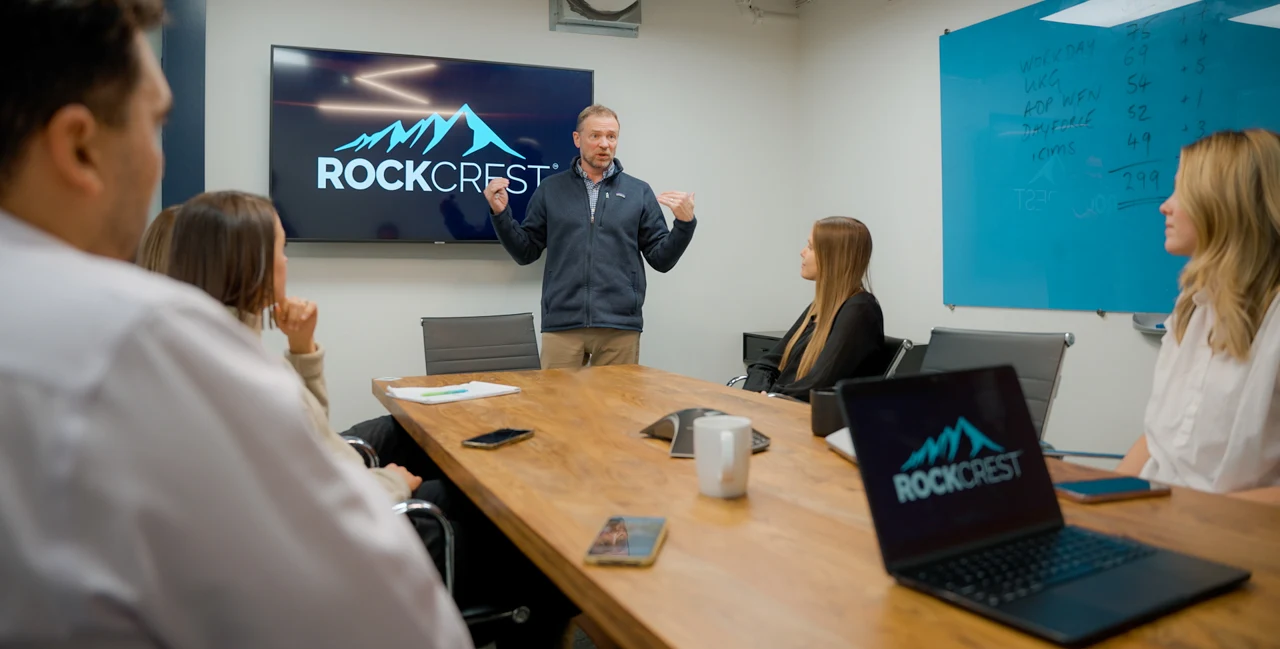


"I feel like the business is on the track it should be on. I was slightly off, and Rob just helped me identify where I was getting off the rails and how to get back on. It's been really, really helpful."
— Richard des Moulins

ROCKCREST is a consulting firm specializing in human capital management (HCM) technology. The company works with chief HR officers, HR directors, and HR professionals on technology-related projects and initiatives, from selecting and implementing new HR systems to optimizing and maintaining existing ones. Their clients are typically small-to-medium enterprises with 100 to 500 employees.
.webp)
Founder Richard des Moulins built the business over nearly two decades as a solo consultant. After relocating to Colorado with his wife five years ago, the pandemic lifted, and an opportunity emerged: it was time to grow beyond a one-person operation. Richard began hiring, bringing on consultants, support staff, and eventually leadership roles, building toward the firm he'd always envisioned.
Three years into that expansion, ROCKCREST had grown to roughly eight employees. The business was moving in the right direction, but the pace wasn't matching Richard's ambition. Some early hires hadn't worked out. Growth felt slower than it should. And Richard, who had spent 17 years making every decision himself, was starting to recognize that the next chapter would require a different kind of leadership than what had brought him this far.
The turning point came at the Mile High SHRM conference. Richard watched Fahd Alhattab deliver a presentation and was immediately drawn to his energy and approach, "very animated and full of life," as he described it. By the end of the talk, Richard knew he wanted to introduce himself.

"I thought, this is a guy I should go introduce myself to and say, this is who I am, this is what I do, can you help me?" — Richard des Moulins, Founder, ROCKCREST
Richard hadn't actively been searching for a coach. But the timing aligned with a growing realization: after three years of building, he was ready for a thought partner who could help him see the business and his own leadership with fresh eyes. As he put it, it was "more just being at the right place at the right time with the right need."
A fifteen-minute conversation at the conference led to a follow-up call with Fahd, which led to an introduction to Rob, a coach whose background and style felt like a natural fit. They shared a British background, had attended the same university around the same time, and even knew some of the same people. But beyond the personal connection, Richard found Fahd honest, down-to-earth, and structured in his methodology. He didn't shop around. The connection was immediate, and he trusted the instinct.
Before coaching, Richard would have rated himself a six out of ten as a leader. He'd managed teams earlier in his career, running a recruitment business in the UK with a partner for six years, but that experience was decades old and largely self-taught. "No formal training in it," he said. "I sort of learned on the fly."
Now, leading a growing consulting firm, some familiar patterns were surfacing. Richard was deeply involved in the day-to-day operations of the business, hiring, training, managing client relationships, handling finances, and overseeing delivery, all at once. The work was getting done, but at a cost.
"I had it in my head that I wanted to do these things, but I wasn't actually doing them. I was too involved in the day-to-day, which didn't give me enough time to focus on the more strategic things I should have been working on."
Richard had five or six strategic initiatives he knew the business needed, projects that would position ROCKCREST for its next phase of growth. But between managing the team and staying close to client delivery, those priorities kept getting pushed aside. It wasn't a question of vision. It was a question of capacity and approach.
From the first session, Rob took a methodical approach. He spent the early calls getting to know the business deeply, its structure, its market, its challenges and getting to know Richard as a leader: his strengths, his style, how he devoted his time, how he made decisions. By the end of the second session, Richard felt Rob had "a lot of it nailed." The pace surprised him with productive homework, clear direction, and a sense that progress was happening quickly.
By the third or fourth session, they had mapped out a set of priorities for the next two to three years. Richard identified five or six strategic initiatives, and Rob contributed additional perspective. From that point forward, every monthly session had a dual focus: tracking progress on those long-term goals, and working through the leadership questions that surfaced along the way.
The sessions weren't structured around any single framework or methodology. Instead, they were driven by dialogue, Rob asking the right questions, listening carefully, and helping Richard think through problems he'd been circling on his own. Every call ran to the edge of the allotted time, and Richard always left with clear next steps.
"It was more just the conversations, the questioning, the determining, and the allowing me to speak and explain why. He was a very good listener as well as a questioner." Richard shared.

The most significant shift in Richard's leadership has been stepping back from the operational weeds. Before coaching, he was deeply involved in every aspect of the business a natural instinct for a founder who'd run things solo for nearly two decades. Rob helped him see that this involvement, while well-intentioned, was creating a ceiling.
Richard now catches himself in those moments and makes a conscious choice to step back. "Just don't do that," he tells himself. "Let them figure it out. They've got to figure this out on their own. Don't do it for them and don't check up on them so much." It's a habit that's still developing, something he'll readily acknowledge, but the awareness alone has changed how he leads.

The biggest takeaway from coaching, in Richard's words, has been learning to give people genuine ownership not just tasks, but projects they can shape, lead, and take pride in. "How can I ensure that they are taking responsibility for this, and this is their success? It's not just me telling them what to do. It's that they are running with it genuinely themselves."
That principle is now visible across the organization. The head of marketing, hired four months ago, is running the entire marketing and business development function. The content manager is generating their own ideas and executing independently. Two other team members are leading the firm's exploration of AI and building out a client success program. Each team member has been given space to own their area, and they're stepping into it.
One of the most meaningful outcomes of Richard's coaching journey has been his decision to invest in leadership development for his team, starting with Sarah, his first internal promotion to a management role.
Sarah oversees a team of five consultants and is responsible for mentoring, training, and delivery oversight. Richard recognized that while he could advise her on recruiting and client situations, formal leadership training would give her the foundation he himself had gone without for too long.
"I know that one of the things that held me back was a lack of formal training in leadership. And I don't want the same for her. I want her to flourish and grow", Richard shared.
Richard enrolled Sarah in one-on-one coaching with Rob, the same coach who knows the business, the culture, and the context. It was a deliberate choice. Having the same coach working with both the founder and the emerging leader creates alignment and deeper insight. As Richard explained, the more Rob gets to know the managers directly, the more productive their own sessions become. "He's not relying purely on my feedback. He's got his own opinions, and I trust his opinion."
Richard plans to extend the same investment to future managers as the team grows, a sign that leadership development is becoming embedded in ROCKCREST's culture, not treated as a one-time fix.
The shifts Richard described in how he leads, stepping back, empowering ownership, and investing in his team's development, are reflected in the team's baseline data as well.
As part of the coaching engagement, Richard's team completed Unicorn Labs' Team Dynamics Assessment (TDA), which measures team health across the Six Levels of High-Performing Teams from foundational Psychological Safety through Empowerment, Communication, Leadership Culture, Purpose, and Vision.
Across all six dimensions, ROCKCREST scored in the "High" range, a strong foundation for a team that's still actively scaling.
The highest score, Culture of Leadership at 4.49, aligns directly with the coaching work Richard and Rob have been doing. Team members reported strong marks on learning opportunities, initiative-taking, and follow-through on commitments. That tracks with Richard's intentional shift toward giving people real ownership rather than managing from the centre.
Empowerment (4.33) and Effective Communication (4.41) also stand out. For a team that was, until recently, dependent on a single founder for nearly every decision, these scores reflect the structural changes Richard has made: clearer roles, delegated authority, and a growing leadership bench. The team isn't just being told what to do, they're running with it.
The lowest score, Sense of Purpose at 4.10, is still comfortably in the High range but represents the team's biggest area of opportunity. This is common in fast-growing consulting firms where the work is client-driven, and day-to-day demands can overshadow the bigger picture. As ROCKCREST scales toward 15 people, deepening that shared sense of purpose, connecting each person's contribution to the firm's trajectory, will be an important next step.
Notably, the micro-management question within Psychological Safety scored 3.6, the lowest individual item on the assessment. It's a candid data point that reinforces what Richard himself acknowledged: letting go of the day-to-day is a work in progress. The fact that he's aware of it, actively working on it with Rob, and the team still scores 4.28 overall on Psychological Safety speaks to the trust that already exists.
.png)