


The Conflict Resolution Workshop Agenda Your Team Actually Needs (With Scripts)
Here's a scene I've watched play out dozens of times.
A leadership team books a conference room, orders lunch, and blocks off three hours for a "conflict resolution training session." The facilitator opens a slide deck. There are definitions on screen. There's a quadrant model. People nod politely. Someone asks a safe question. By 2 pm, everyone's back at their desks, and nothing has changed.
The problem isn't that workplace conflict training doesn't work. The problem is that most training programs treat conflict like a concept to understand rather than a skill set to practice. And there's a massive difference between understanding that you should listen more and actually sitting across from a colleague, holding eye contact, and resisting the urge to defend yourself while they tell you something hard.
This is the conflict resolution workshop agenda I wish someone had handed me ten years ago. It's built from real-life facilitation work with startup teams, informed by the Thomas-Kilmann model, Kim Scott's Radical Candour, and Pixar's Braintrust framework. It includes the scripts. It includes the role-play scenarios. And it's designed to move your team members from avoiding hard conversations to having them with skill and care.
You can run this as a half-day in-person workshop or break it into two shorter sessions. Either way, what follows is a step-by-step guide that goes well beyond theory.
Why Most Conflict Resolution Activities Miss the Point
Before we get into the agenda, I want to note something that most conflict-resolution training gets wrong.
Most training sessions focus on de-escalation. They teach people how to de-escalate situations, find common ground, and reach a compromise. And while those are useful skills, they're downstream skills. They assume the conflict has already erupted.
The real problem on most teams isn't that people fight too much. It's that they don't fight enough. Or more precisely, they don't engage in the kind of productive, passionate, candid debate that actually makes teams better. Ed Catmull, the co-founder of Pixar, put it bluntly: "If there are people in your organization who feel they are not free to suggest ideas, you lose."
The silence is what kills you. The meetings where everyone nods along. The Slack channels where nobody pushes back. The performance review where you say "everything's great" because the real conversation feels too risky. That's not peace. That's artificial harmony. And artificial harmony is where team performance stagnates.
Effective conflict resolution starts upstream. It starts with helping your team members understand their own relationship with conflict, reframing it from something dangerous to something necessary, and then practicing the actual communication skills that make productive disagreement possible.
That's what this agenda is designed to do.

The Full Workshop Agenda: A Conflict Resolution Training Session in Six Parts
- Total time: 3 to 3.5 hours
- Group size: 6 to 30 team members
- Materials: Flipchart or whiteboard, markers, printed worksheets (templates linked below), timer
- Best for: In-person delivery, though sections can be adapted for virtual delivery
Part 1: The Mindset Shift From "Nice" to "Candid" (30 minutes)
Goal: Reframe conflict as a tool, not a threat.
This is the most important section of the workshop, and it has nothing to do with skill-building. It's about mindset. If your team members walk in believing that conflict is inherently negative, no amount of templates or frameworks will help them. You have to shift the frame first.
Opening exercise (10 minutes): Hand out the "What Is Your Relationship with Conflict?" reflection sheet. Ask each person to write, privately, their honest answers to three questions: What's the first emotion you feel when someone disagrees with you? What's the last conflict you avoided, and why? What would change if your team could disagree without it getting personal?
Give them five minutes to write. Then ask for two or three volunteers to share. The facilitator's job here is not to teach. It's to normalize. When a senior leader admits they avoid conflict, too, it gives everyone permission to be honest.
Key teaching (15 minutes): Introduce the Conflict Continuum. On one end: artificial harmony, where people walk on eggshells, and no one says what they really think. On the other end: mean-spirited attacks, where people use honesty as a weapon. In the middle: productive conflict, where team members debate ideas passionately because they care about the work and they care about each other.
Write this on the flipchart: "Conflict is the journey to truth."
This framing comes from Patrick Lencioni's work and is one I return to regularly. The goal isn't to eliminate disagreement. The goal is to make disagreement safe, skilled, and focused on the work. When teams avoid conflict, decision-making slows, resentment builds, and your best people start keeping their best ideas to themselves. That's not teamwork. That's a group of people in the same room pretending to agree.
Group discussion (5 minutes): Ask the large group: "Where on this continuum does our team usually land? And where do we want to be?" Don't push for a resolution here. Just let the conversation surface what's real.
Part 2: Understanding Your Conflict Style The TKI Model (30 minutes)
Goal: Build self-awareness about default conflict behaviours.
Teaching (10 minutes): Introduce the Thomas-Kilmann Conflict Mode Instrument. It maps conflict management styles along two axes: assertiveness (how much you push for your own needs) and cooperativeness (how much you accommodate the other person's needs). The five styles are:
Competing: High assertiveness, low cooperativeness. Win/Lose. You push for your point of view at the expense of the relationship.
Accommodating: Low assertiveness, high cooperativeness. Lose/Win. You give in to keep the peace, even when you disagree.
Avoiding: Low on both. Lose/Lose. You sidestep the conflict entirely and hope it goes away. (It won't.)
Collaborating: High on both. Win/Win. You work with the other person to find a solution that satisfies everyone. This takes the most emotional intelligence and the most time, but it produces the best outcomes.
Compromising: Middle on both. Partial Win/Partial Win. You each give something up. Faster than collaborating, but neither side is fully satisfied.
.png)
Here's the thing most people don't realize: none of these styles is inherently bad. There are real-world conflict situations where competing is the right call, a safety issue, a deadline that can't move. There are moments where accommodating makes sense, the issue is small, and the relationship matters more. The problem isn't the absence of a default style. The problem is only having one.
Activity (15 minutes): Have team members complete the Conflict Styles Assessment Worksheet. Score it in the room. Then break into small groups of three or four and discuss: What's your dominant style? When does it serve you? When does it get in the way?
Debrief (5 minutes): Reconvene the large group. Ask: "What surprised you about your results?" Write themes on the whiteboard. You'll often hear things like, "I thought I was collaborative, but I'm actually an avoider." That self-awareness is the foundation on which everything else builds.
Part 3: The Feedback Framework Radical Candour and SBI (30 minutes)
Goal: Give team members a practical tool for delivering difficult feedback.
Teaching (10 minutes): Introduce Kim Scott's Radical Candour framework. The premise is simple: the best feedback happens when you care personally and challenge directly. When you care but don't challenge, you get ruinous empathy the kind where you're so worried about hurting someone's feelings that you never tell them the truth. When you challenge but don't care, you become obnoxious. And when you do neither, you get manipulative insincerity, the most dangerous quadrant, where people smile to your face and complain behind your back.
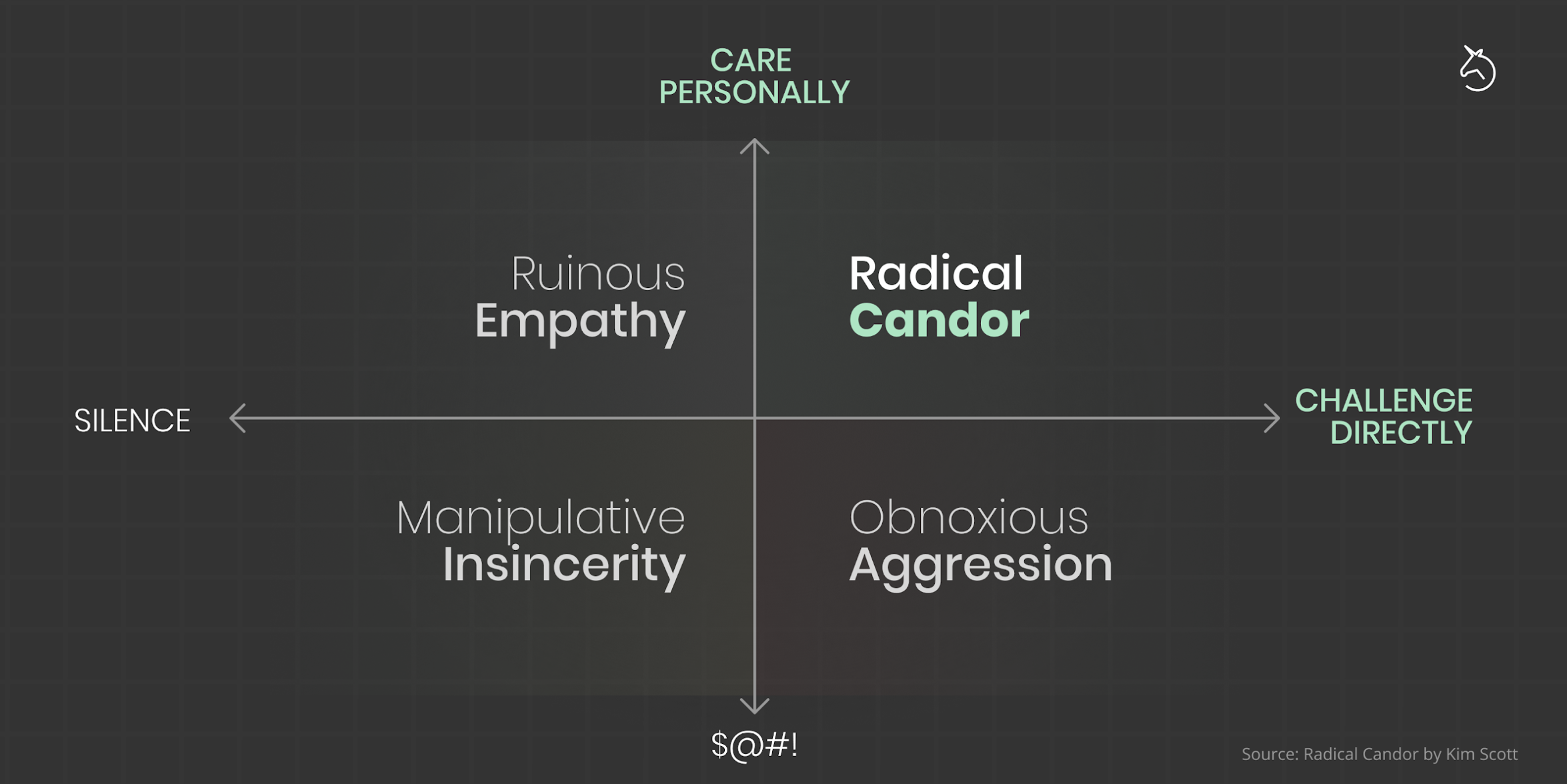
Then introduce the SBI model, Situation, Behaviour, Impact, as the delivery tool for radically candid feedback. SBI strips judgment out of feedback and focuses on observable facts.
The script template:
"In [Situation], when you [Behaviour], the impact was [Impact]."
Example (write this on the flipchart):
Instead of: "You're always interrupting people in meetings."
Try: "In yesterday's product meeting [Situation], when you cut Sarah off mid-sentence twice [Behaviour], she stopped contributing for the rest of the meeting and told me afterward she felt dismissed [Impact]."
The difference is night and day. The first version attacks the person. The second version describes what happened and why it matters. It's specific. It's factual. And it opens a door for problem-solving rather than defensiveness.
Role-play exercise (15 minutes): Break into pairs. Hand out three conflict scenarios printed on cards, real-world situations like: a team member who consistently misses deadlines, a colleague who takes credit for shared work, or a direct report whose body language in meetings signals disengagement. Each person practices delivering feedback using the SBI model while their partner practices active listening, no interrupting, no defending, just listening and reflecting back what they heard.
This is where the real learning happens. Not in the teaching. In the practice.
Debrief (5 minutes): Ask: "What was harder, giving the feedback or receiving it?" The answer almost always reveals something important about the team's communication styles and listening skills.
Part 4: Navigating Tension in the Moment De-escalation Scripts (25 minutes)
Goal: Equip team members with language for when emotions run high.
Teaching (10 minutes): When people feel threatened in a conflict situation, they default to one of two responses: silence or violence. Silence looks like withdrawing, nodding along while seething, changing the subject. Violence looks like raising voices, making it personal, and steamrolling the other person's point of view. Neither produces resolution.
The skill here is learning to name the dynamic without escalating it. We call this "labelling the behaviour to reset the room."
Three de-escalation scripts (write these on the whiteboard):
- The Reset: "Hey, I don't think we're fully hearing each other right now. Can we pause and start this part of the conversation over?"
- The Curiosity Pivot: Instead of "Why did you do that?" (which triggers defensiveness), try: "Can you help me understand your point of view on this? What led you to that conclusion?"
- The Shared Goal Reminder: "I think we both want the same thing here a project that ships on time and a team that feels good about the work. Can we brainstorm a way to get there together?"
Notice that all three scripts accomplish the same thing: they slow the conversation down without shutting it down. They acknowledge different perspectives without taking sides. And they redirect energy from the person to the problem.
Role-play exercise (10 minutes): In pairs, practice the scripts. One person escalates a scenario (the facilitator can provide conflict scenarios on cards a disagreement about workloads, a clash over limited resources, a tension around new roles and responsibilities). The other person practices using one of the three scripts to de-escalate and redirect toward common ground.
Quick debrief (5 minutes): Ask the room: "Which script felt most natural to you? Which felt most uncomfortable?" Discomfort is data. It tells you which skill needs the most practice. Developing effective communication under pressure is a muscle, not a talent. It gets stronger with reps.
Part 5: Systemizing Healthy Conflict Building Your Team's Braintrust (30 minutes)
Goal: Create a repeatable structure for candid team dialogue.
Teaching (10 minutes): This section is modelled on Pixar's Braintrust, one of the most effective conflict resolution activities ever designed, even though Pixar would never call it that. The premise: bring smart, passionate people into a room, charge them with identifying problems in the work, and create a set of ground rules that make candour safe.
The genius of the Braintrust is two things. First, the feedback is about the work, never the person. Second, the Braintrust has no authority; the person receiving feedback decides what to act on. This removes power dynamics from the equation, which is what makes people actually willing to speak freely.
Ed Catmull described it as having four essential ingredients: "Frank talk, spirited debate, laughter, and love."
Group activity (15 minutes): Give each table a flipchart sheet and markers. Their task: create a "Team Conflict Principles" document, five to seven ground rules the team agrees to follow when engaging in debate. Provide these starter prompts:
Opening script for any Braintrust-style meeting: "We're here together in the spirit of inquiry, as comrades, not adversaries. Our shared goal is to find the best path forward on [topic]. There is no winner. The team wins if we make progress."
Examples of principles teams often land on: we challenge ideas, not people. We assume positive intent. We say what we mean in the room, not after the room empties. Silence is not agreement; if you disagree, you say so. We follow up within 48 hours on any commitment made.
Share out (5 minutes): Have each small group read their top three principles to the room. The facilitator consolidates the best ones on a shared whiteboard. This becomes the team's living document, a set of norms to revisit before difficult meetings and during any period where trust needs to be rebuilt.
Part 6: Handling Persistent Conflict The "Bad Apple" Problem (20 minutes)
Goal: Give leaders a framework for addressing individuals who repeatedly undermine team dynamics.
Teaching (10 minutes): Research from Will Felps on "bad apple" behaviour in teams shows something sobering: a single negative team member can reduce group performance by 30 to 40 percent. One person. And the effect isn't proportional to the team size. Even in a large group, one person who consistently checks out, undermines decisions, or brings hostility into the work environment can drag the entire team down.
The instinct most managers have is to ignore it and hope it improves, or to quietly work around the person. Neither works. What does work is addressing the behaviour directly, using the same SBI model from earlier, and tying it back to the team's agreed-upon conflict principles.
The script:
"In our last three team meetings [Situation], you've dismissed two colleagues' ideas without engaging with them and left the meeting early without explanation [Behaviour]. The impact is that other team members have told me they're hesitant to share ideas when you're in the room, and our group discussion quality has dropped [Impact]. This behaviour isn't consistent with our agreed-upon team values. I'd like to understand what's going on and figure out a path forward together."
Notice the structure: specific, factual, tied to team norms, and ending with an invitation to solve it together. This isn't a punishment. It's a conversation. And if repeated conversations with genuine care don't shift the behaviour, that's data too for a performance review and potentially a different kind of decision.
Group discussion (10 minutes): Ask: "What makes it hard to address persistent conflict on a team? What would make it easier?" Let the room sit with this. The answers often reveal the root causes of workplace conflict: fear of retaliation, unclear expectations, and a view that conflict management is HR's job rather than a leadership responsibility.
After the Workshop: Making It Stick
The workshop ends. People file out. Now what? Here's what separates conflict resolution training that actually changes a work environment from the kind that gets forgotten by Monday: follow-up.
Within the first week, schedule a 15-minute check-in at your next team meeting. Ask: "What's one thing from the workshop that you've already tried?" Celebrate the attempts, not just the outcomes. When team members see that you're taking this seriously, they will too.
Post the Team Conflict Principles somewhere visible, such as a shared doc, a Slack channel, or the wall of your meeting room. These shouldn't be filed away. They're a living agreement. Revisit them at least quarterly, and whenever there's an organizational change, a new team member joins, or a shift in team dynamics.
Consider establishing a recurring Braintrust-style meeting, held monthly, with the sole goal of candid feedback on the work. Not status updates. Not celebrations. Just an honest assessment of what's working and what isn't. Pixar calls these "debugging meetings," which focus solely on fixing problems, and the format works remarkably well for teams outside Hollywood.
And perhaps most importantly: model it. The single biggest predictor of whether a team will resolve conflicts in positive ways is whether the leader does. If you use the SBI model in your one-on-ones. If you respond to pushback with curiosity instead of defensiveness. If you admit when you were wrong. Your team is watching. Not for what you say about conflict. For how you handle conflict when it shows up at your door.
The Quiet Truth About Conflict Resolution Skills
Most people think effective conflict resolution is about finding the right words. It's not. It's about building the right conditions, the emotional intelligence to read a room, the psychological safety to speak freely, the shared language to disagree without destroying.
You don't get those conditions from a slide deck. You get them from practice. From role-play that feels awkward at first but teaches your hands the shape of a hard conversation. From sitting in a circle with your team members, a few conflict scenarios on the table, and saying: "Let's try this again. Let's try to find a better way."
Conflict isn't the enemy of great teams. Avoidance is. And the teams that learn to handle conflict with both courage and care don't just survive together. They build something worth fighting for.
That's the real agenda.
Ready to run this workshop with your team?
You don't have to facilitate it alone. Book a War Room Call with our team and we'll help you figure out where your team's conflict dynamics are stuck, which parts of this agenda to prioritize, and how to make it land. It's a call. No pitch deck, no pressure, just a real conversation about your team. → Book a War Room Call
FAQs
Now that you have mastered how to manage conflict - what is your plan of action for making an impact with your team?
Now that you have mastered how to create an environment of empowerment via the 3-P's - what is your plan of action for making an impact with your team?
Developing Your Communication, Empathy and Emotional Intelligence skills is start. What is your plan of action for implementing your learnings within your your team?
Now that you understand the differences in these titles - what is your plan of action for what you learned?
Assessing your team's behaviors is a start - but do you have a plan of action for the results?
Now that you have mastered the art of decision making - what is your plan of action for making an impact with your team?
.png)
A DISC Behaviour Assessment is the best way to understand your team's personalities.
Each DISC Assessment includes a Self Assessment and DISC Style evaluation worksheet
.webp)


