


The Perfect 2-Day Strategy Offsite Agenda for Series B Startups
Table of Contents:
The last strategy offsite I facilitated started with a confession. The CEO pulled me aside ten minutes before kickoff and said, "Fahd, I haven't slept. I keep thinking we're going to waste two days talking in circles and come back with nothing."
He wasn't being dramatic. He'd been through this before. Most founders have. You pull your leadership team off the floor. You rent a nice space. You put together a meeting agenda full of SWOT analysis slides and brainstorming prompts. And by mid-afternoon on Day 1, half the executive team is sneaking glances at Slack, and the other half is having the same argument they have every Tuesday. The strategic offsite becomes an expensive team meeting with better coffee.
Here's what I've learned from facilitating dozens of offsites for startups between Series A and Series C: the problem is almost never the people. It's the agenda. A bad strategy offsite agenda turns your sharpest leaders into passive participants. A good one turns 48 hours into the most important decision-making window of your quarter.
This is the two-day offsite agenda template we use at Unicorn Labs. It's not a rigid script. It's a playbook you can shape to fit your team.
Why Most Strategic Planning Sessions Fail Before They Start
The first mistake happens weeks before anyone boards a plane. Most founders skip the pre-work, then wonder why their leadership teams spend the first three hours just getting on the same page.
Pre-work is not optional. It's the single biggest predictor of whether your offsite meeting will produce clarity or confusion. At minimum, every team member should arrive having reviewed the company's current roadmap, the most recent financial snapshot, and a brief reflection prompt: What is the one strategic question we're avoiding?
That last question matters more than the data. It surfaces what the group really needs to talk about, and gives your facilitator (internal or external) the raw material to design sessions that actually matter.
The second mistake is scope. Founders love to cram annual planning, goal setting, a team-building exercise, a product deep dive, and a culture conversation into two days. That's not strategic planning. That's a conference.
A strong two-day offsite does one thing well: it helps your leadership team make the three to five decisions that will define the next 90 to 180 days. Everything in the agenda should serve that outcome.
-23.jpg)
The Pre-Offsite Checklist: What to Lock In Before Day 1
Before you build your offsite agenda, get these five things sorted. Skip any of them, and you'll pay for it later.
- Define the strategic question. Not "what's our strategy?" That's too broad. Something specific: "Do we double down on enterprise or invest in self-serve?" or "How do we hit $10M ARR without burning through the runway?" The question focuses on the entire two days.
- Assign pre-work. Send a short briefing document at least one week before. Include key data, the strategic question, and 2 to 3 reflection prompts. Ask team members to submit written responses beforehand so the facilitator can identify where alignment already exists and where the real tension lives.
- Set ground rules. No laptops during sessions. Phones on silent. What's said in the room stays in the room. These aren't corporate formalities. They're the conditions for psychological safety, the foundation of honest, strategic conversation. If your team can't speak candidly in this room, your offsite planning will produce polite fiction, not real strategy.
- Choose the right space. In-person is non-negotiable for this kind of work. Pick a location away from the office with natural light, access to a whiteboard, and enough room for small-group breakouts. The space shapes the energy.
- Decide on facilitation. If you're the CEO, you should not be running this. You need to be in the conversation, not managing it. An external facilitator keeps the group honest, manages the clock, and creates space for voices that are often drowned out. At Unicorn Labs, every offsite we run is built around the Six Levels of High-Performing Teams, because strategic planning without team trust is theatre.
Day 1: Align on Reality
The goal of Day 1 is simple: get every person in the room looking at the same map. Not the map they wish existed. The real one.
Morning: Kickoff and Strategic Context (9:00 AM to 12:00 PM)
Open with a check-in. Not an icebreaker where everyone shares their favourite movie. A real one. Go around the room and ask each person: "What's the thing you're most worried about heading into the next quarter?" This sets the tone. It tells the group that honesty is the currency of these two days.
Follow the check-in with a State of the Business review. Whoever owns each domain (product, revenue, operations, people) presents a five-minute snapshot. No slide decks longer than five slides. No rehearsed pitches. Just the truth: where we are, where we thought we'd be, and the gap between the two.
Then open it up for group discussion. What patterns are you seeing across domains? Where are the dependencies that nobody's naming? A skilled facilitator will push past the polite layer here, because the gap between what stakeholders say publicly and what they believe privately is where the real strategy session begins.
Afternoon: The Hard Conversation (1:30 PM to 5:00 PM)
This is where the real work happens. Take the strategic question you defined in pre-work and put it on the whiteboard. Break the leadership team into small group discussions of three to four people. Give each group 45 minutes to build a case for a different path forward. Then bring everyone back together and let the tension play out.
This is not brainstorming. Brainstorming is what teams do when they're avoiding commitment. This is structured problem-solving with a deadline. Each group presents their thinking. The room debates. The facilitator tracks decisions and open questions on a visible board.
By the end of Day 1, you should have narrowed from five possible directions to two or three. You should also have a shared understanding of the key tradeoffs. What are we gaining? What are we giving up? Effective decision-making at the leadership level is not about finding the perfect answer. It's about making a committed decision with incomplete information and moving forward.
Evening: Informal Connection
Dinner together. No agenda. No structured team-building activity. Just shared time. Conversations over dinner often do more for teamwork and alignment than anything on the formal agenda. This is where belonging cues form. Daniel Coyle's research shows that the small moments of connection, what we call "Mac and Cheese Moments," are the glue that holds cross-functional teams together through hard quarters.
Day 2: Decide and Commit
Day 1 was about seeing clearly. Day 2 is about choosing and building a path forward.
Morning: Decision Sprint (9:00 AM to 12:00 PM)
Start with a brief reflection. "What shifted for you overnight?" Give the group 10 minutes to share their thoughts after sleeping on it. Then move into the decision sprint.
Take the two or three options from yesterday and stress-test them. Use a premortem: "It's 6 months from now, and this initiative failed. What went wrong?" This forces the group to think about risk before they fall in love with the plan. It's one of the most underused tools in strategic planning sessions, and it consistently surfaces blind spots that open discussion alone misses.
By mid-morning, make the call. Choose the strategic direction. This is where the CEO earns their role. Not by dictating, but by synthesizing what the room has surfaced and making a clear decision that the team can commit to, even the people who argued for a different path.
Then translate the decision into an action plan. For each major initiative, define: What are we doing? Who owns it? What does success look like in 90 days? What are the first three next steps? Write it on the whiteboard. Take photos. These become the living document.
Afternoon: Operational Roadmap and Accountability (1:30 PM to 4:00 PM)
Now translate the strategy into the day-to-day. Map each initiative to existing team capacity. Identify what you'll need to stop doing to make room for what's new. This is the part that most planning meetings skip entirely, and it's the reason most offsite action plans die within three weeks.
Assign owners. Set check-in cadences. Define what a 30-day follow-up meeting looks like. The accountability architecture you build this afternoon is what turns a good strategy session into lasting behaviour change.
Close with a round-the-room commitment. Each person answers: "What's one thing I'm personally committing to as a result of these two days?" Not what the company is doing. What they are doing. Building a culture of leadership today, matters more than ever, it means every person in that room leaves with ownership, not just awareness.
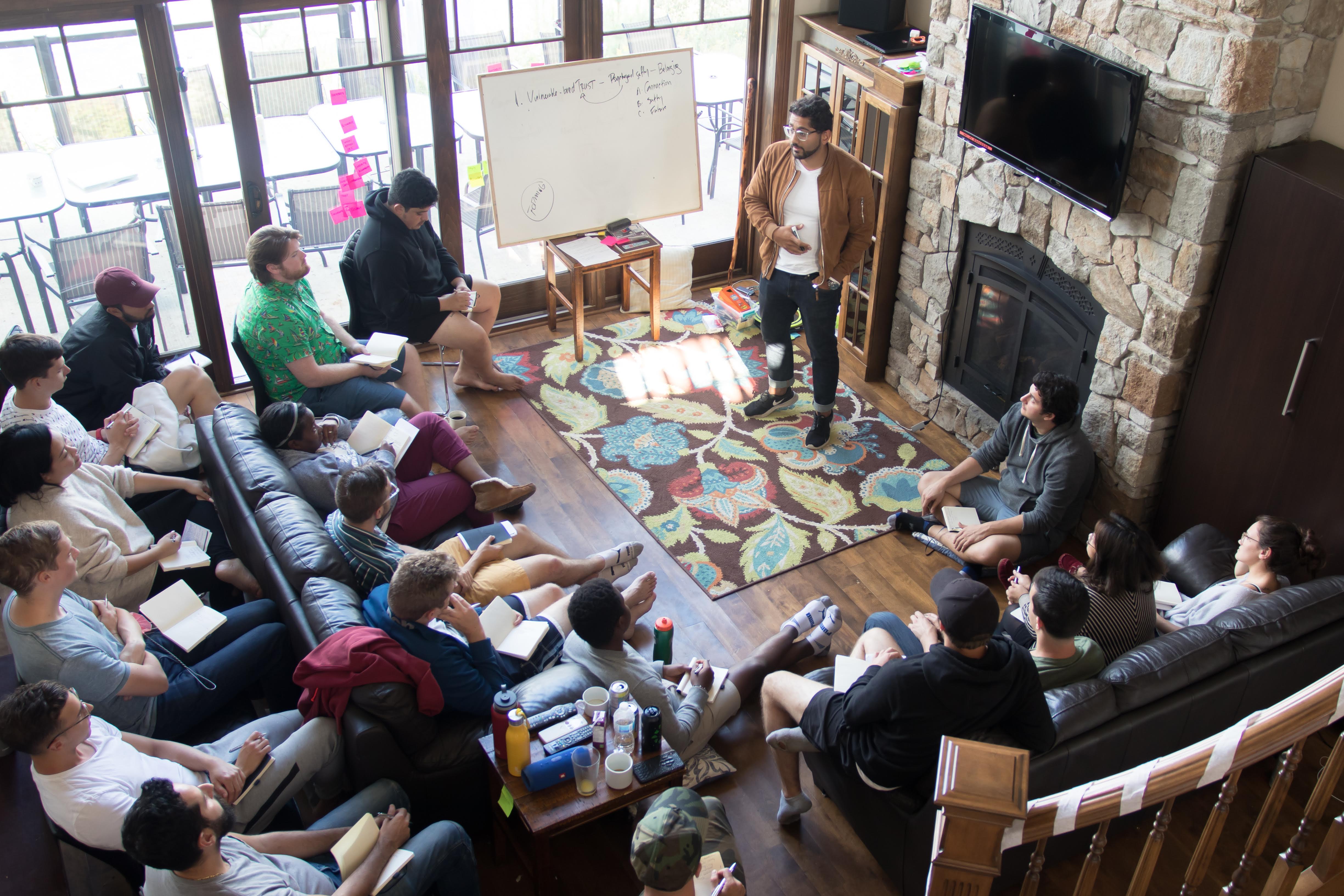
The Follow-Up That Makes or Breaks It
Most offsites die in the follow-up. The energy fades. The Slack channels fill back up. The "urgent" reclaims its territory from the "important." Here's how to prevent that.
Within 48 hours, send a summary document to every attendee with the key decisions, owners, and deadlines. Within two weeks, hold the first follow-up check-in. Keep it short: 30 minutes. Are we on track? What's blocking us? What's changed?
Then build the offsite rhythm into your operating cadence. Quarterly is the minimum for a startup at this stage. The companies I've seen grow fastest are the ones where strategic offsites aren't a special event. They're a regular practice.
What Two Days Can Actually Change
That CEO who couldn't sleep before his offsite? His team left those two days with three clear initiatives, defined owners, and a 90-day roadmap they actually executed. Six months later, he told me the offsite didn't just change their strategy. It changed how the team made decisions together. The real output wasn't the plan. It was the trust.
That's what a well-designed offsite agenda does. It doesn't give your startup a strategy deck. It gives your leadership team the confidence to move together.
Ready to build your next offsite? Book a diagnostic call with our team and we'll help you design a strategic offsite built around how your leadership team actually works.
FAQs
A two-day format is the evidence-backed standard for Series B startups running a quarterly or annual strategy offsite. Day one should be dedicated to diagnosis — reviewing data, surfacing misalignment, and naming the real strategic tensions — while day two is reserved for decision-making and roadmap commitments. Organizations that try to compress this into a single day often skip the diagnostic phase, which means decisions get made without shared context and fail to stick. Structured offsites that follow this two-day arc consistently help teams cut decision timelines by 20–30% in the quarter that follows.
The most effective strategy offsites include the full senior leadership team plus two to three high-context individual contributors who can ground strategic conversations in operational reality. For Series B companies, this typically means eight to fourteen participants — large enough for diverse perspectives, small enough for genuine deliberation. Excluding key operational owners from the room leads to strategic plans that break down in execution because the people responsible for delivery had no voice in design. If the CEO is the only one who can answer critical questions in the room, the team is not yet operating as a leadership team.
External facilitation is strongly recommended once your leadership team exceeds six people or when alignment is genuinely contested — both conditions are common at the Series B stage. A founder or CEO who also facilitates is forced to choose between leading the conversation and participating in it, which almost always produces a weaker result on both dimensions. External facilitators from firms like Unicorn Labs, founded by Fahd Alhattab, are specifically trained to hold space for difficult strategic conversations while keeping the team moving toward concrete decisions. The facilitation investment is typically a fraction of the cost of a single misaligned quarter.
A well-run strategy offsite should produce three to five prioritized strategic bets, clear ownership assignments, and documented decision criteria for the quarter ahead — not just a slide deck. Research shows that well-connected, aligned teams are up to 25% more productive, and companies with robust team alignment strategies see up to a 73% decrease in voluntary turnover. The offsite itself is not the outcome; it is the conditions for better execution. Teams that leave with written commitments and a follow-up cadence are significantly more likely to translate offsite energy into measurable results.
Now that you have mastered how to manage conflict - what is your plan of action for making an impact with your team?
Now that you have mastered how to create an environment of empowerment via the 3-P's - what is your plan of action for making an impact with your team?
Developing Your Communication, Empathy and Emotional Intelligence skills is start. What is your plan of action for implementing your learnings within your your team?
Now that you understand the differences in these titles - what is your plan of action for what you learned?
Assessing your team's behaviors is a start - but do you have a plan of action for the results?
Now that you have mastered the art of decision making - what is your plan of action for making an impact with your team?
.png)
A DISC Behaviour Assessment is the best way to understand your team's personalities.
Each DISC Assessment includes a Self Assessment and DISC Style evaluation worksheet
.webp)


