


SeQent is an industrial automation software company and an early pioneer in the Industrial Internet of Things, with two decades of experience and thousands of installations worldwide. Their platform bridges industrial automation systems and the communication devices that plant teams actually use, so that alarms, events, and notifications reach the right people in real time, whether that's on a Motorola two-way radio, a smartphone, a PA speaker, a pager, or a display on the plant floor.
SeQent's customers span automotive and technology manufacturers, where uptime on the floor isn't a nice-to-have but a daily operating reality.
Based in London, Ontario, SeQent is a small team of around two dozen people running a business with deep roots. Founded in the 1990s and now serving customers globally, the company sits at an unusual intersection: a mature, category-leading product with decades of installed base, paired with the energy of new ownership.

β
When Michael and Sheret took over SeQent, the business was already working. It had customers, a real product, and a defensible niche. What the new owners wanted was to ensure the team was moving in the same direction and shared the same understanding of where the company was headed, and to put that in place early, while the company was still taking shape under new leadership.
That instinct came from experience. Michael and Fahd had worked together once before, at a previous company of Michael's, where the strategic foundation, vision, plan, and operating rhythm had come together later than Michael would have liked.
"The business was doing well, but the alignment came together later than it should have."
Michael Levine
This time, Michael wanted to get ahead of it. And there was a second layer to the opportunity: he and Sheret had inherited a team, several of whom had been with the company for years. Rather than walk in and hand down a directive from the top, they saw an opportunity to bring those long-tenured team members into shaping the company's mission, vision, and strategy, building shared ownership from the start.
"I think a lot of [the longtime team] really appreciated that we leveraged them for the mission, the vision, the strategy."
Michael Levine
The goal was alignment; the whole team had a hand in building, not alignment that was announced to them.
Michael knew the kind of structure he wanted. He had read Traction and was drawn to the EOS model as a way to bring discipline to strategy and execution. So he looked at EOS implementers and came away unconvinced.
"It was a lot too hands-off," he explained. "It was kind of just, hey, we got a session, there's a playbook... and that's all kind of on your own."
There was a question of fit, too. Standard EOS, in Michael's view, carried more weight than a company of SeQent's size needed. "I find parts of it are very heavy for a business of our size," he said. He didn't want to install a rigid system. He wanted a partner who would help him decide what to keep, what to leave, and how to shape it around the business he actually had.
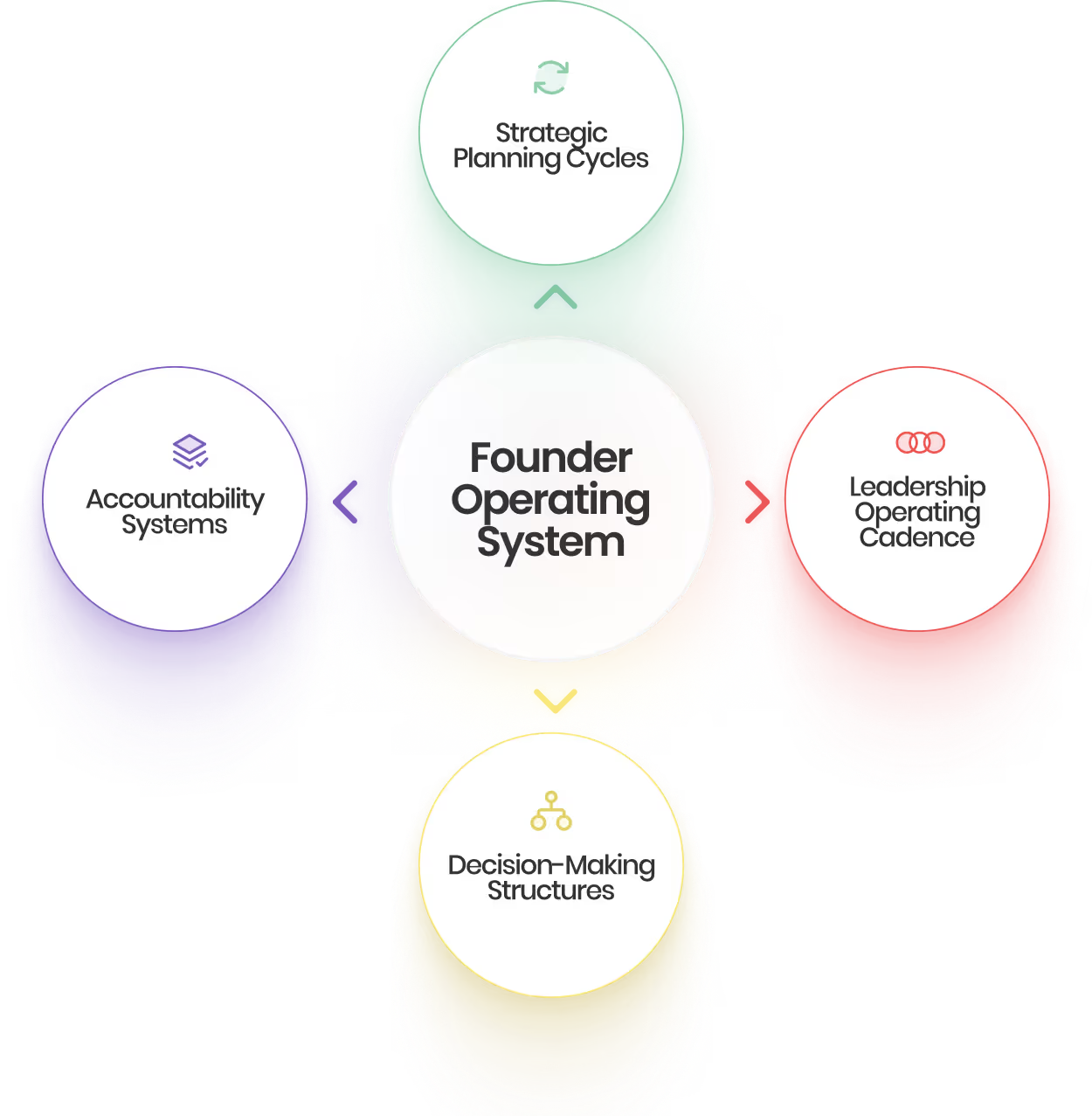
That pointed back to Fahd. The two had history, the trust was already there, and Fahd's Founder Operating System covered the same ground Michael was after, with the flexibility to tailor it. Michael and Sheret made the call together to bring Unicorn Labs in for the year ahead.
β
β
The engagement followed the shape of a Founder Operating System rollout, scaled to fit a smaller team: an in-person annual planning retreat to do the heavy strategic lifting, quarterly off-sites to keep the plan live, and monthly coaching sessions delivered virtually.
Onboarding was deliberately light. Michael doesn't recall a heavy intake process, and for an engagement this lean, that was the point. What he does remember is the pre-work landing ahead of each session, and the quality of what came back afterward.
The facilitation work happened in person. The coaching happened virtually. That split β intensive in-person sessions for the big strategic moments, lighter-touch virtual coaching to maintain momentum β fit the rhythm of a small, busy team.
β
β
Across the interview, Michael kept returning to one theme: the facilitation itself was where the value lived.
"Eighty to ninety percent of the success is just that the team bought in. What you actually do is kind of irrelevant sometimes... Are we aligned, and are we all working on the right things?"
Michael Levine
He could read a room and adapt.
Michael credited Fahd's ability to set the agenda aside when the moment called for it. He recalled one session that drifted somewhere unproductive, and Fahd's instinct to pause and run a feedback session instead.
"It's good when it's a third party... someone who's not in the weeds, doesn't have biases."
A neutral facilitator did something a founder running his own meeting can't: it let Michael step out of the judge-and-jury role and actually participate in the debate alongside his team.
"He's like a normal guy... he runs his own business. We all get along with him. He's funny."
Michael had sat through facilitation before that didn't land, past sessions where nobody in the room connected with the facilitator. Fahd was different. For a quiet, technical team, that mattered.
β
The clearest sign the work took hold is what's happening without Michael in the room.
"It's just on its own cascading down," Michael said, "and that's not even me doing it." For a business where structured priorities and goals were still "a bit of a culture shock," watching the operating rhythm spread on its own is a meaningful shift.
It surfaces in live sales calls, and team members call out the values when they recognize each other. "That's been a pretty amazing little benefit," he said. "It's not just thrown on a wall and stale, which is so common."
The purpose, values, and mission now shape the company's sales decks. The annual OKRs the team built with Fahd became the basis for the executive compensation plan, and Michael and Sheret brought those same OKRs to the board as the measure they wanted to be held to.
Formal performance management hasn't been built out because the team is still lean. But the direction is set: SeQent is hiring for its values now, and plans to manage performance against them down the line.
"My big win for the whole game is just team alignment."
Michael Levine
Michael pointed to the executive-team alignment at SeQent as a standout result: the team is transparent about its issues, with no one trying to hide problems.
It's worth being straight about one thing in Michael's own framing. He doesn't claim the strategy itself would have been wildly different without Unicorn Labs. "I don't think it's too different from what I would have just pushed down from the top." What changed was how it was arrived at. Having Fahd distill it, draw it out from the whole team, and build buy-in along the way turned a top-down plan into a shared one.
As Michael put it: without that, "we would have definitely given up on a lot of the upfront alignment and team buy-in and just energy at the off-sites... and I said from the beginning, I think that is almost more important sometimes."
β
.png)
β
The relationship is continuing. Michael is committed to keeping Fahd for off-site facilitation, and sees a strong case for running the two-day annual retreat as the kickoff.
"I feel like I'm not contributing as much as I could if Fahd's doing it."His reasoning is practical: it's hard to both facilitate and participate.
"I think he's a really good fit for this section of the market."
Michael has already put the recommendation into practice; he connected another first-time operator with Unicorn Labs after seeing what executive coaches were charging elsewhere. He was thoughtful about where the fit is strongest, distinguishing between "professional CEOs" and what he affectionately calls "gunslinging CEOs," newer operators, often first-timers, running smaller and startup-stage companies.
"We're happy," Michael said. "It's been good, and we've enjoyed it."

Tablz Case Study
ROCKCREST Case Study
Helcim Case Study