
-23.avif)


DiSC Communication Styles: How Tech Teams Stop Talking Past Each Other
Your engineering lead sends a three-paragraph Slack message explaining a technical decision. Your product manager replies with "sounds good." Your designer says nothing. And your engineering lead spends the rest of the day wondering if anyone actually read it.
This isn't a personality clash. It's a communication styles problem. And it's costing your team more than you think.
The Real Cost of "We Just Don't Communicate Well"
Miscommunication costs companies roughly $9,284 per employee per year, according to Grammarly's workplace research. For a 100-person tech company, that's nearly $1 million annually. Burned on duplicated work, unclear direction, and meetings that should have been messages (or messages that should have been meetings).
But here's what most leaders miss: the problem isn't that people don't communicate enough. It's that they communicate differently. Your direct, results-first VP of Engineering isn't being rude. Your empathetic, people-first People lead isn't being soft. They're just running on different operating systems.
That's where DiSC comes in.
What DiSC Actually Is (And What It Isn't)
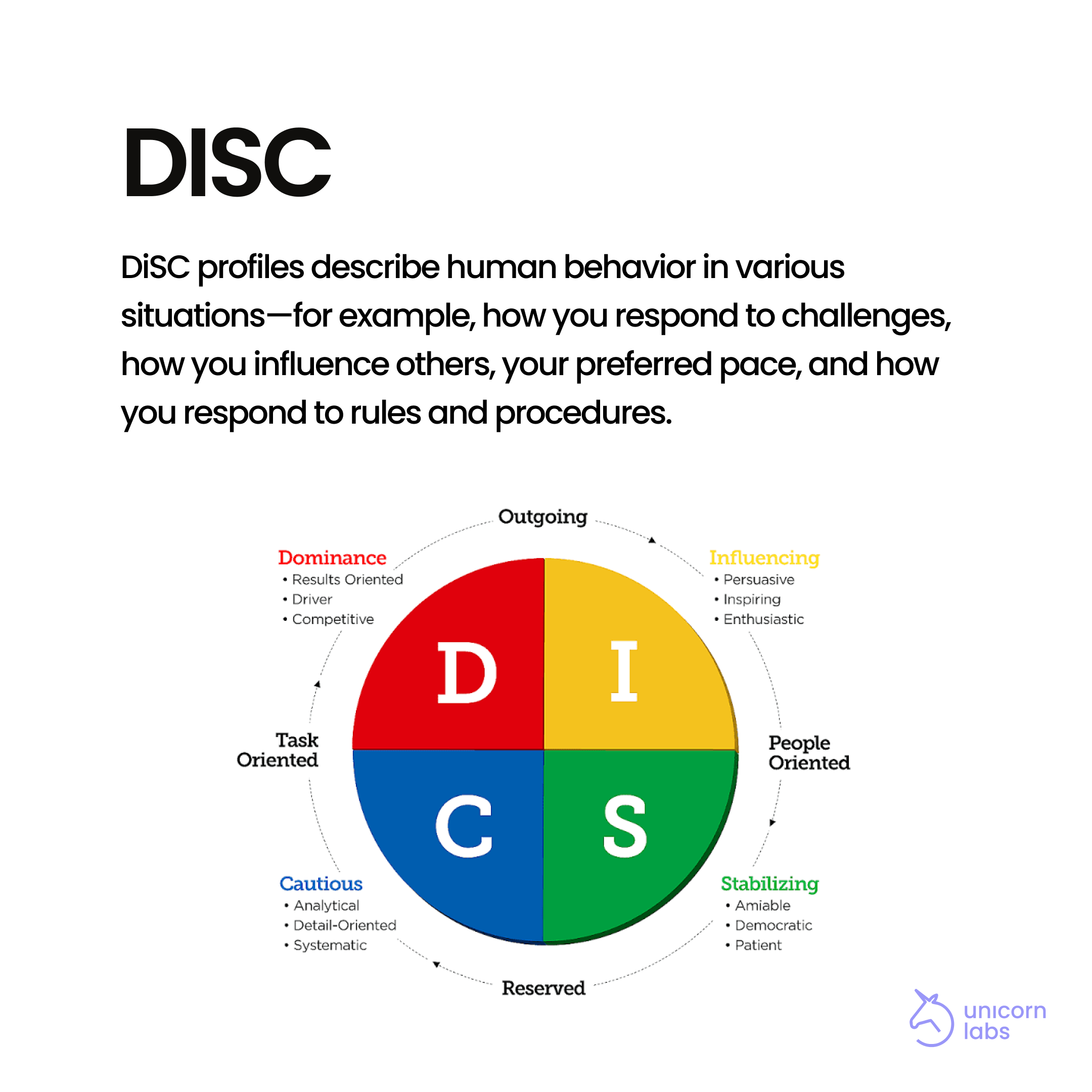
DiSC is a behavioural framework that maps how people naturally communicate across four styles:
D (Dominance): Direct. Bottom-line. "Just tell me what you need." These folks want results and they want them fast. They'll cut through pleasantries to get to the decision. In tech, your founders and engineering leads often show strong D tendencies.
i (Influence): Enthusiastic. Collaborative. "Let's brainstorm this together!" They thrive on energy, storytelling, and buy-in. Your product managers and sales leaders often land here.
S (Steadiness): Patient. Supportive. "Let's make sure everyone's on board." They value consistency and harmony. Many of your senior engineers and operations folks bring this energy.
C (Conscientiousness): Analytical. Precise. "Show me the data." They want accuracy and logic before action. Your backend engineers and QA leads often lean C.
Here's what DiSC is not: a box. Nobody is purely one style. Most people blend two or three. The point isn't to label. It's to understand. When you understand how your team's brains are wired, you stop taking things personally and start communicating on purpose.
Over one million people take the DiSC assessment every year. It's been validated through nearly 50 years of research with a 90% accuracy rating. This isn't a BuzzFeed quiz. It's a tool that works.
Why This Matters More in Tech Than Anywhere Else
Tech teams have a unique communication challenge that most industries don't face: you're putting radically different thinkers in the same room and expecting them to build things together.
Your C-style backend engineer wants to write a detailed RFC before touching any code. Your D-style founder wants to ship it by Friday. Your i-style product manager wants to get the whole team excited about the vision first. Your S-style designer wants to make sure nobody feels steamrolled by the timeline.
None of them are wrong. All of them feel frustrated.
Research from Harvard Business Review found that teams using personality assessments like DiSC improved project delivery times by 20%. Not because people changed who they were, but because they learned to flex. A D-style founder who knows their PM needs enthusiasm before direction starts the conversation differently. A C-style engineer who knows their founder values speed leads with the recommendation, then backs it up with data.
This is what we call psychological safety in action. When people feel understood, not fixed, they speak up more, push back more productively, and build trust faster.
The Four Conversations That Break Tech Teams
After facilitating hundreds of DiSC workshops with scale-up leadership teams, I've noticed the same four communication breakdowns showing up again and again:
1. The Feedback Collision
A D-style manager gives blunt feedback: "This isn't working. Redo it." An S-style report hears: "You failed." The manager thinks they're being clear. The employee is crushed.
The fix: D-styles need to add 10 seconds of context. "I think you're capable of something stronger here. Let me share what I mean." Same directness. Completely different impact.
2. The Meeting That Went Nowhere
An i-style leader runs a brainstorm. Ideas fly everywhere. Energy is high. But nothing gets decided. The C-styles leave confused. The D-styles leave frustrated.
The fix: Split the meeting in two. Diverge first (i-style heaven), then converge (D and C heaven). Give everyone a runway that matches how they think.
3. The Silent Disagreement
An S-style team member disagrees with the sprint plan but doesn't say anything because they don't want to "cause problems." Two weeks later, the work stalls because the issue they saw coming actually came.
The fix: Create structured check-ins where S-styles can raise concerns in writing first. "What's one risk you see that we haven't discussed?" gives them the opening without putting them on the spot.
4. The Data vs. Gut War
A C-style analyst presents a 40-slide deck. A D-style exec says, "Just give me the answer." Both leave the meeting feeling disrespected.
The fix: Lead with the recommendation (one slide), then offer the appendix. C-styles still get to do the thorough work. D-styles get the speed they need. Everyone wins.
These aren't personality defects. They're predictable patterns. Once you see them, you can't unsee them. And that's the point. This connects directly to how we think about conflict resolution at Unicorn Labs. Most team conflict isn't about the issue. It's about the style.
How to Actually Use DiSC With Your Team (Try This Monday)
Knowing your styles is step one. Using them is where the magic happens. Here's a practical rollout that takes less than a month:
Week 1: Assess. Have everyone take the DiSC assessment. Share results openly. This only works with transparency. Post styles in Slack profiles or team wikis. Make it visible, not precious.
Week 2: Map your team. Plot everyone on a DiSC grid. Where are the clusters? If your engineering team is 80% C and S, you now know why the brainstorming sessions feel forced. If your leadership team is 90% D and i, you know why the engineers feel unheard.
Week 3: Create style agreements. This is the step most teams skip, and it's the most important. Each pair or pod agrees on communication norms:
Week 4: Debrief. After one month, run a retro. What communication improved? Where are you still clashing? What agreements need updating?
This isn't a one-and-done exercise. The teams that get the most from DiSC are the ones that keep referencing it: in 1:1s, in sprint planning, in how they approach conflict.
The Deeper Issue: Your Best People Are Leaving Because They Feel Misunderstood
Here's the thing nobody says out loud: your retention problem might be a communication problem.
Gallup's 2025 report shows that 51% of workers say poor communication increases their stress. Teams with poor communication are 50% less productive. And when your top performer, the quiet, steady S-style who holds everything together, finally quits, they won't tell you the real reason. They'll say "better opportunity." What they mean is "nobody here speaks my language."
The manager gap is real. Most tech companies promote their best engineers into management roles without teaching them how to communicate across styles. A brilliant C-style engineer becomes a manager and leads every 1:1 with data. Their i-style direct report just wants to feel heard first. Neither one knows what's going wrong.
DiSC gives them the vocabulary to figure it out.
It's Not About Changing Who You Are
I want to be clear about this: DiSC isn't about becoming someone you're not. A D-style founder doesn't need to become warm and fuzzy. An S-style engineer doesn't need to start being confrontational.
It's about range. The best communicators aren't the ones who pick one style and perfect it. They're the ones who can flex. Who can shift from direct to empathetic, from analytical to enthusiastic, depending on who they're talking to and what the moment requires.
That's leadership. Not being right, but being understood. Your team already has everything it needs. They just need a shared language to unlock it.
Ready to see how your team communicates and where the gaps are? Take our Team Dynamics Assessment to map your team's communication patterns and get a personalized roadmap for building trust and performance.
Frequently Asked Questions
Now that you have mastered how to manage conflict - what is your plan of action for making an impact with your team?
Now that you have mastered how to create an environment of empowerment via the 3-P's - what is your plan of action for making an impact with your team?
Developing Your Communication, Empathy and Emotional Intelligence skills is start. What is your plan of action for implementing your learnings within your your team?
Now that you understand the differences in these titles - what is your plan of action for what you learned?
Assessing your team's behaviors is a start - but do you have a plan of action for the results?
Now that you have mastered the art of decision making - what is your plan of action for making an impact with your team?
.png)
A DISC Behaviour Assessment is the best way to understand your team's personalities.
Each DISC Assessment includes a Self Assessment and DISC Style evaluation worksheet
.webp)


