


The Six Levels of High-Performing Teams: A Complete Framework Guide
Your best engineer just handed in their notice. No warning, no drama. Just a Slack message and a calendar invite for "a quick chat." And the worst part? You kind of saw it coming, because the last six months have felt off. The team is talented. The product is solid. But something isn't adding up. The whole keeps coming out less than the sum of its parts.
That's the puzzle the Six Levels of High-Performing Teams framework was built to solve. Not just to name what's broken, but to tell you exactly where to look, and what to do first.
Why Talent Alone Doesn't Build a High-Performing Team
Here's something I've seen play out dozens of times across tech scale-ups: you can hire the most decorated engineers, the sharpest PMs, the most experienced marketers, and still end up with a team that underperforms, miscommunicates, and slowly burns itself out.
According to Gallup's 2024 State of the Global Workplace Report, global employee engagement fell to 21%, the second decline in 12 years. Manager engagement dropped from 30% to 27%. And here's the number that should stop you cold: 70% of team engagement is directly tied to the manager. Not the ping-pong table. Not the equity package. You.
Most leadership programs respond to this by throwing isolated fixes at the wall. A communication workshop here. A conflict resolution session there. An offsite that ends with a ropes course and a lot of optimism. Symptoms get treated. Root causes don't.
The Six Levels of High-Performing Teams fixes that. It gives you a diagnostic lens, a sequential, dependency-based framework that tells you exactly which level to examine when something breaks, and why trying to fix a Level 4 problem while ignoring a Level 1 issue will always fail.
This is the philosophical backbone of everything at Unicorn Labs: from our 12-week Company Leadership Development Program to team retreats, keynotes, and coaching. And I'm going to walk you through the whole thing.
What Is the Six Levels of High-Performing Teams Framework?
The Six Levels of High-Performing Teams is the proprietary framework I've built at Unicorn Labs to help managers and founders at tech scale-ups turn groups of talented individuals into cohesive, high-performing teams.
Unlike frameworks that treat team performance as a single dimension, the Six Levels operates as a dependency model. Each level builds on the one below it. You can't sustainably unlock Level 3 without Level 2 in place. You can't hold Level 2 without Level 1. This isn't theoretical, it's the reason so many "culture and vision" offsites fail. Leadership teams try to build shared vision (Level 6) on a foundation of low trust and unclear decision-making authority (Levels 1 and 2). The structure collapses.
The framework came out of years of working directly with hundreds of leaders at fast-growing Canadian and North American tech companies, combined with research from organizational psychology, Google's Project Aristotle, and the neuroscience of trust and motivation.
It answers one question every founder, CEO, and VP People should care about: what actually separates high-performing teams from everybody else?
Unlike frameworks that treat team performance as a single dimension, the Six Levels operates as a dependency model. Each level builds on the one below it. You can't sustainably unlock Level 3 without Level 2 in place. You can't hold Level 2 without Level 1. This isn't theoretical, it's the reason so many "culture and vision" offsites fail. Leadership teams try to build shared vision (Level 6) on a foundation of low trust and unclear decision-making authority (Levels 1 and 2). The structure collapses.
The framework emerged from years of working directly with hundreds of leaders at fast-growing Canadian and North American tech companies, combined with research from organizational psychology, Google's Project Aristotle, and the neuroscience of trust and motivation.
At its core, it answers one question every founder, CEO, and VP People should care about: What actually separates high-performing teams from everybody else?
The Six Levels: An Overview
The Six Levels, in sequence:
- Psychological Safety. The floor. Without it, nothing above holds.
- Empowerment. Distributed decision rights. People act, not just ask.
- Effective Communication. Productive conflict instead of artificial harmony.
- Culture of Leadership. Leadership as a behaviour, not a title.
- Sense of Purpose. Work connected to meaning.
- All-Encompassing Vision. A shared north star that creates pull.
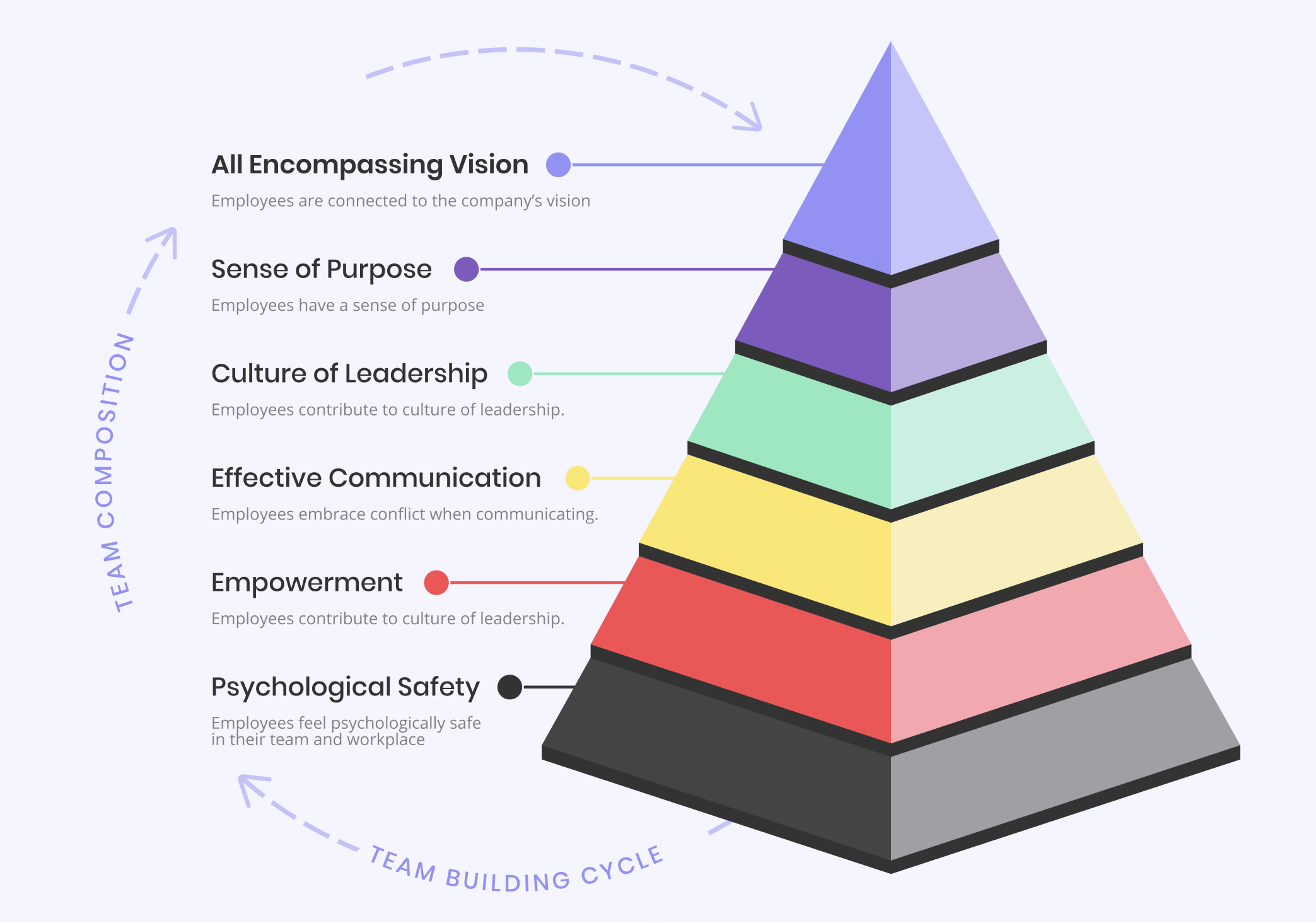
The dependency structure is everything. This is why Unicorn Leaders don't chase culture at the top without building the floor first. When 1+1=3 on a team, it's not an accident, it's what happens when all six conditions are in place.
Level 1: Psychological Safety: The Non-Negotiable Foundation
What It Is
Think about the last time someone on your team told you they'd made a mistake — before it became a crisis. If you're struggling to remember one, you've got a psychological safety problem.
Psychological safety is the belief that you won't be punished or humiliated for speaking up with ideas, questions, concerns, or mistakes. Harvard Business School professor Amy Edmondson coined the term, and her research has been replicated across hundreds of teams and industries.
Google's Project Aristotle, a multi-year study of 180 teams, identified psychological safety as the single most important factor in team performance. The researchers ranked five dynamics in order of impact: psychological safety first, then dependability, structure and clarity, meaning, and impact. Teams with strong cultures were rated effective by executives twice as often as low-safety teams, kept more of their talent, and brought in more revenue. Counterintuitive finding worth sitting with: the high performers report more mistakes than the low performers. Not because they make more, but because they're willing to talk about them.
The framework builds on Timothy Clark's four stages of safety: Inclusion Safety → Learner Safety → Contributor Safety → Challenger Safety. Your goal as a leader is to move your team all the way to Challenger Safety: where people feel safe enough to question the status quo, including you.

In a high-psychological-safety environment, team members feel safe to:
- Admit mistakes before they become crises
- Ask "stupid" questions without performance anxiety
- Push back on the most senior person in the room
- Float a half-baked idea and let it get torn apart
- Say "I don't know" without losing credibility
What It Looks Like When It's Missing
When psychological safety is low, smart people self-censor. Meetings become performances. Nobody challenges the loudest voice in the room. Post-mortems become blame sessions. The best ideas, the uncomfortable, contrarian, half-baked ones, never get voiced.
Your team looks functional on paper. The real conversations happen in Slack DMs after the meeting ends.
I've run the Pasta Tower Experiment with hundreds of teams, an exercise where kindergarteners routinely outperform MBA students on creative problem-solving. You know why? Because the kids don't care about looking stupid. They iterate, experiment, and collaborate without ego in the way. The MBAs spend half their time jockeying for status. That pattern plays out in every team you've ever been on.
Diagnostic Questions for Level 1
- When was the last time someone admitted a mistake to you before it became visible to everyone?
- Do junior team members challenge senior people in meetings, or only nod along?
- After your last bad meeting, did the real conversation happen in Slack DMs?
- Are you hearing about more problems and mistakes than you used to, or fewer?
- Can someone on your team disagree with you publicly without softening it into a question?
How to Build It
Your behaviour is the most powerful lever. Psychological safety is built by modelling vulnerability, admitting your own mistakes publicly, before anyone asks. Reward people for raising uncomfortable truths. Separate feedback about ideas from judgments about people. And do it consistently, not just at the annual retreat.
One thing I always tell managers: the first time someone brings you bad news, your reaction becomes a story the whole team tells about whether it's safe to bring you bad news again.
Level 2: Empowerment: Trust That Actually Does Something
What It Is
Psychological safety creates the conditions for people to speak up. Empowerment creates the conditions for them to act.
Empowerment is the organizational design that lets team members make decisions confidently within their domain — without needing manager approval at every step. It requires structural clarity: each person must understand their role, their decision-making authority, and how their work connects to team outcomes.
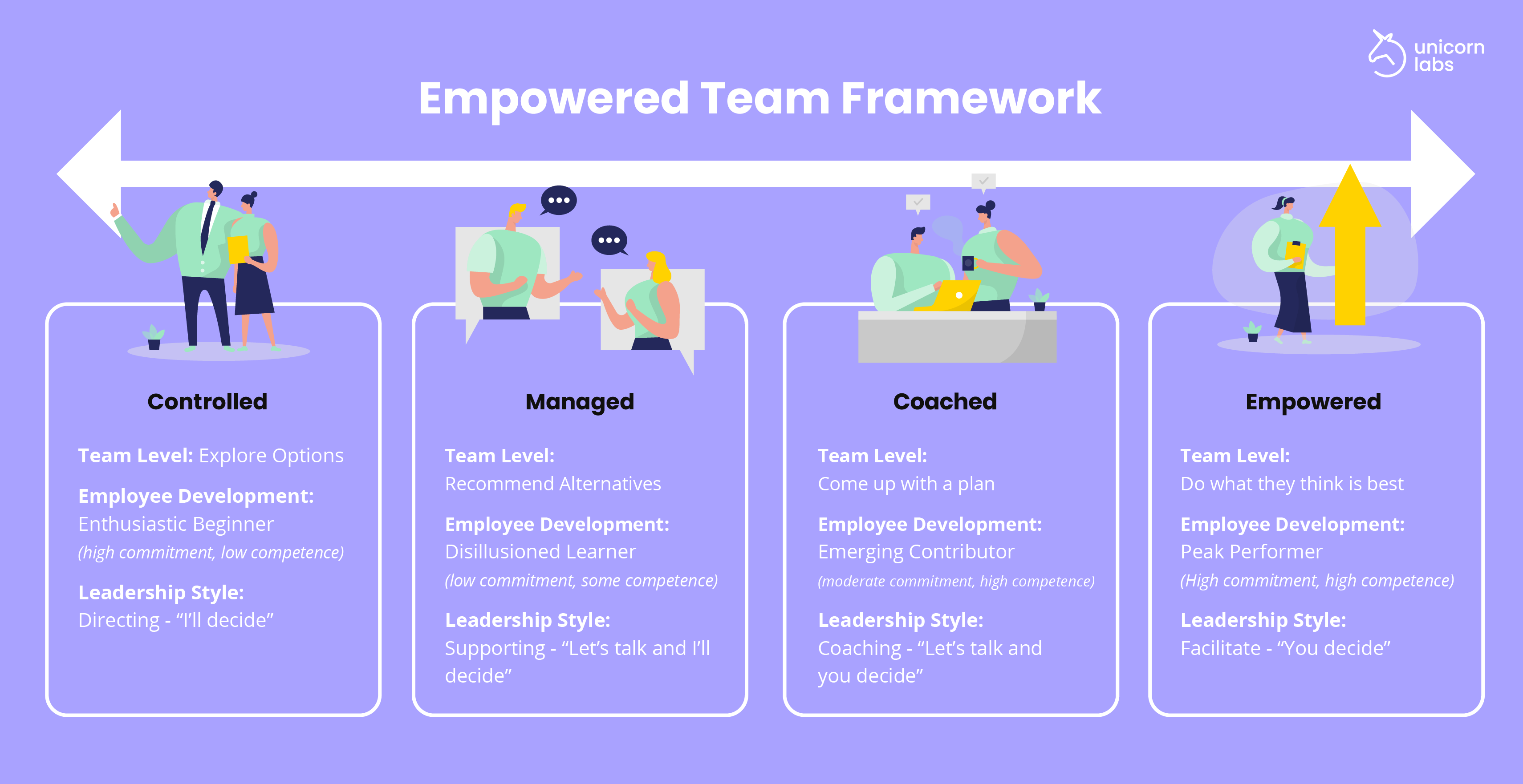
Empowerment isn't just delegating tasks. It's pushing decision-making downward with clear frameworks so people can act without creating bottlenecks or chaos. Think of it as a spectrum: Controlled → Managed → Coached → Empowered. Your job as a leader is to move people to the right, not to pull them back left when they make imperfect calls.
What It Looks Like When It's Missing
You've seen this. Your team is talented, but everything routes through you. Every decision, no matter how tactical, ends up in your inbox. Meetings stall because "we need to check with [manager]" on decisions that should have been resolved two levels down.
At 10 people, a founder can be involved in everything. At 50, that approach cuts execution speed in half. At 150, it causes the kind of gridlock that sends your best people to your competitors. This is exactly the David vs. Goliath moment, where scrappy teams beat bigger ones not by having more resources, but by moving faster and thinking for themselves.
Diagnostic Questions for Level 2
- Could three of your direct reports name the decisions they're allowed to make without checking with you?
- If you went on vacation tomorrow for a week, what stalls?
- Are you the bottleneck on decisions that should never have reached you?
- When someone makes a call you wouldn't have made, do you commit to it or quietly reverse it?
- Where does your team sit on the spectrum from Controlled to Empowered? Could they tell you?
How to Build It
Define decision-making frameworks explicitly. Tools like RACI (Responsible, Accountable, Consulted, Informed) and OKRs help draw clear lines. But the deeper work is cultural: you need to let go of decisions that don't require you, and resist the pull to re-insert yourself when outcomes are imperfect. Letting someone make a call and learn from it is a leadership act. Stepping back in the moment they're wrong is babysitting with a fancier title.
Level 3: Effective Communication: Healthy Conflict as a Feature, Not a Bug
What It Is
Here's where it gets counterintuitive. The marker of great communication on a team isn't harmony. It's productive conflict.
When people feel safe and empowered, they start voicing real opinions. They challenge proposals. They disagree in meetings. That's exactly what you want. Research from Harvard Business Review consistently shows that teams engaging in healthy debate outperform those optimizing for consensus.
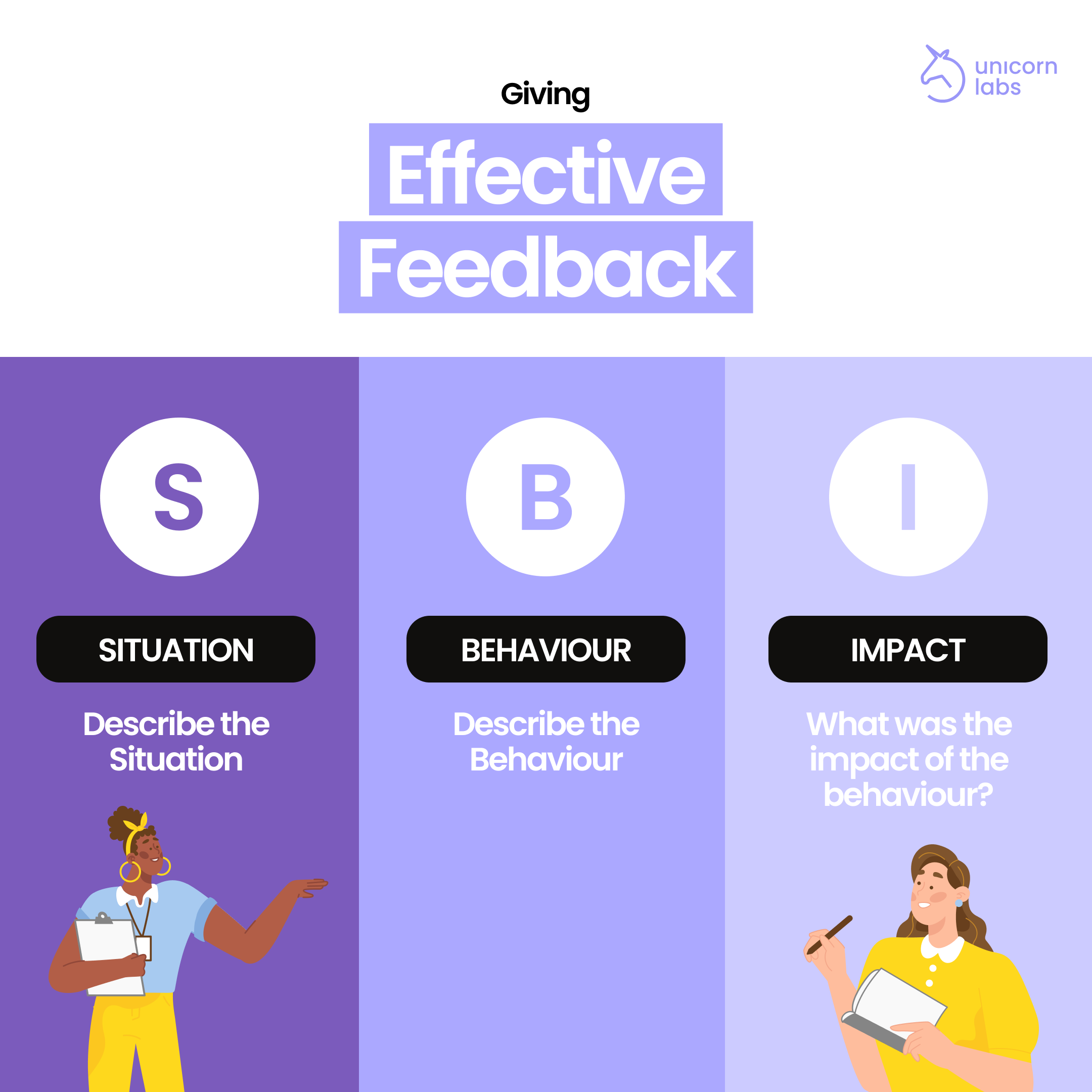
The key distinction is between conflict about ideas (generative) and conflict about people (destructive). Great communication frameworks: Radical Candour, the SBI Feedback Model, Kim Scott's "care personally, challenge directly", all point to the same truth: the goal is to fight for the best idea, not to fight the person holding a different one.

What It Looks Like When It's Missing
Meetings feel productive but nothing actually gets resolved. Everyone agrees in the room and dissents in the hallway. The team produces "polite" output, ideas nobody objects to because nobody feels safe enough to object. Comfort masquerades as alignment.
And then the decision gets relitigated three weeks later, because it was never actually made.
Diagnostic Questions for Level 3
- Do meetings end with clear decisions, or do those same decisions get relitigated next week?
- When was the last time you publicly changed your mind based on a team member's pushback?
- Does dissent live in the meeting, or in the hallway after?
- Can your team disagree about an idea without it becoming personal?
- Have you asked "What's the strongest argument against this?" in your last three big decisions?
How to Build It
Model productive conflict from the top. If your decisions are never challenged, either nobody feels safe enough, or you've accidentally signalled that challenge is unwelcome. Start small. Ask "What's the strongest argument against this?" Make it normal to change your mind based on team input. Nothing signals psychological safety faster than a leader who publicly says, "You were right. I was wrong."
Level 4: Culture of Leadership: When Everyone Leads
What It Is
Level 4 is where individual capability starts multiplying. A Culture of Leadership means leadership isn't a title, it's a behaviour anyone can exhibit within their domain. The marketer leads on brand. The engineer leads on architecture. The customer success manager owns the client relationship strategy.
This is what organizational psychology calls "distributed leadership," and the data is clear: teams with fluid, distributed leadership outperform hierarchical ones in complex, fast-moving environments. Which is exactly the environment your scale-up is operating in.
The goal isn't to create followers. It's to create more leaders. That's what Jim Collins calls Level 5 Leadership, and it starts with one manager choosing to develop their people instead of their own authority.
What It Looks Like When It's Missing
Title determines voice. The most junior people stay silent even when they have the most relevant expertise. Decisions get escalated not because they need senior input, but because the culture hasn't made distributed authority normal. You end up with an organization that moves slowly and underutilizes half its own talent.
Diagnostic Questions for Level 4
- Who leads when you're not in the room?
- Do junior people own projects end-to-end, or are they always executing someone else's vision?
- When someone shows leadership outside their title, does the team notice and reward it publicly?
- Is "leadership" a behaviour on your team, or just a level on the org chart?
How to Build It
Recognize leadership behaviour at all levels, publicly and specifically. When someone steps up, names a problem, and drives a solution, say it out loud in the team meeting. Create structured opportunities for team members to lead: project ownership, presentations to leadership, facilitating retrospectives. Leadership becomes a habit through repetition, not through a promotion.
Level 5: Purpose: The Internal Motivator
What It Is
Purpose is the bridge between daily work and the mission it serves. It answers the question every engaged, and every disengaged, employee is silently asking: Does my work actually matter?
External motivators drive behaviour up to a threshold. Above it, research from Harvard Business Review consistently shows that intrinsic motivation, purpose, mastery, autonomy, is what drives discretionary effort and long-term engagement. Daniel Pink calls these the direct motives. The framework borrowed from Doshi and McGregor calls them Play, Purpose, and Potential, and they're the ones that actually make people care about the outcome, not just the output.
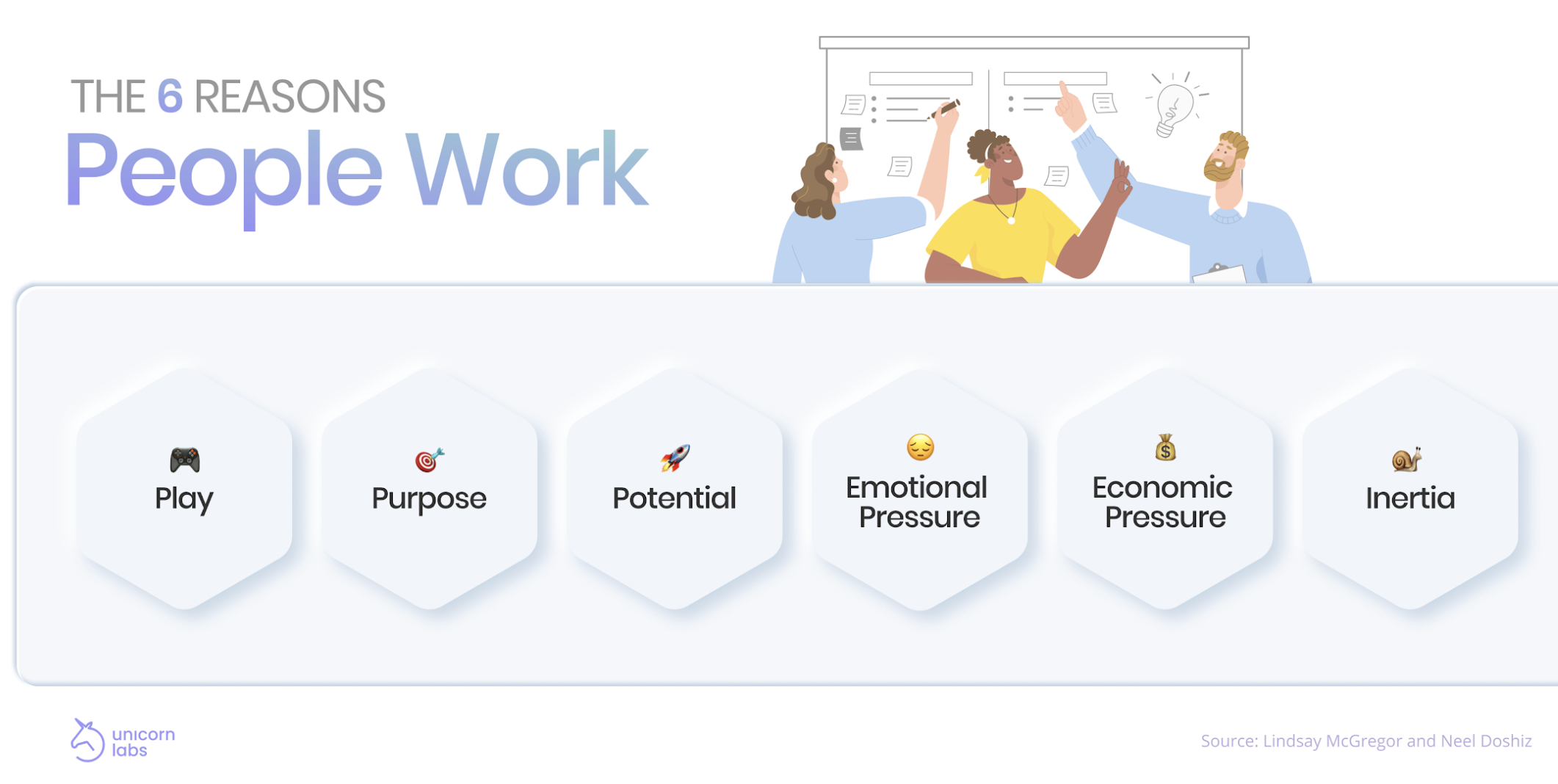
For tech teams specifically, purpose is often what separates the teams that keep top engineers through a turbulent scale-up from the ones that hemorrhage senior talent right when they need it most.
What It Looks Like When It's Missing
Turnover spikes in the 18–24 month range. Performance reviews reveal people who are technically solid but "not as invested" as they used to be. Smart people start treating work as transactional. The startup energy that defined the early team gets replaced with the going-through-the-motions quality of a mid-market bureaucracy.
You hired for passion. You ended up with compliance.
Diagnostic Questions for Level 5
- Can each member of your team articulate why their work matters, beyond hitting quarterly targets?
- When was the last time you connected a team member's work to a real customer outcome, in person?
- Are your top performers more invested in the mission than they were 18 months ago, or less?
- Do your 1:1s ever touch what energizes someone, or only what's blocking them?
How to Build It
Purpose isn't manufactured by a leadership team and handed down. It gets discovered in conversation. Regular 1:1s that explore what energizes people. Customer stories that show the real-world impact of what the team built. Explicit connections between quarterly goals and company mission. The manager's role here is translator, between individual effort and organizational meaning. That translation has to happen constantly, not once a year at the all-hands.
Level 6: Vision: The North Star
What It Is
Vision is the crowning level, the shared, compelling picture of the future that unifies the entire team and points them in the same direction. When all five previous levels are in place, vision becomes a force multiplier. A team that's psychologically safe, empowered, communicating well, leading at every level, and connected to purpose is ready to run hard toward a shared north star.
Jim Collins calls these BHAGs: Big Hairy Audacious Goals. The kind of vision that creates pull, not just direction. The kind that makes people get out of bed on a Tuesday morning in February when nothing is going right, because they know what they're building and why it matters.
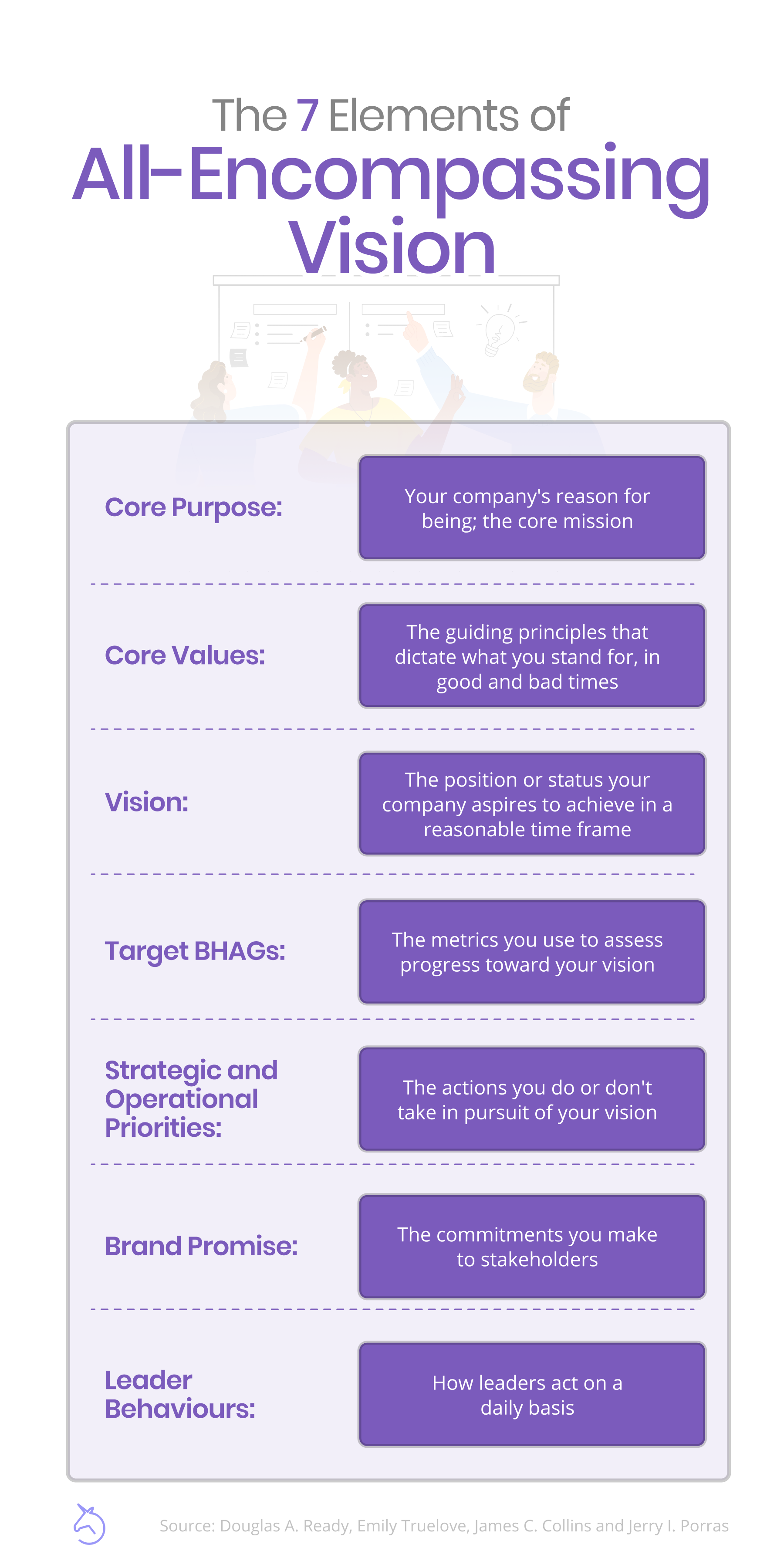
This is also why many strategic planning exercises fail. Leadership teams try to build vision without the foundation. They get alignment in the room and fragmentation in execution, because the underlying conditions for sustained commitment don't exist.
What It Looks Like When It's Missing
The team is busy, but not coordinated. Multiple "strategic priorities" compete for bandwidth. People are executing well individually but not amplifying each other. Quarterly planning feels like negotiating competing demands rather than aligning around a shared mission.
The whole is less than the sum of its parts. That's not a talent problem. It's a ceiling problem.
Diagnostic Questions for Level 6
- If you asked five people on your team to describe the company's vision, would you get five answers or one?
- Are your quarterly priorities pulling in the same direction, or competing for bandwidth?
- Did your team co-create the vision, or did it land in their inbox from an offsite they weren't part of?
- Does the vision still feel alive in February, or only at January kickoff?
How to Build It
The most powerful visions are co-created, not delivered. Don't present the vision to your team — run structured strategic conversations that surface what the team believes the organization should build, solve, or become. The vision that emerges from that process is owned by the team, not just the CEO. That ownership is what drives execution when things get hard. And things always get hard.
How the Six Levels Compare to Other Team Frameworks
The Six Levels sits within a broader tradition of team effectiveness models. Here's how it stacks up against the most widely used alternatives:
Why the Six Levels Is Different
Three things set the Six Levels apart:
1. Dependency over checklist. Most frameworks treat team health as a list of attributes to optimize in parallel. The Six Levels is sequential. You can't build the ceiling before you build the floor, and trying to skip levels is the most common reason culture work fails.
2. Prescriptive, not just descriptive. Lencioni tells you what's broken. Tuckman tells you which stage you're in. The Six Levels tells you what to do next, with diagnostic questions, levers, and tools at each level.
3. Built for scale-ups, not Fortune 500s. The framework was developed inside tech scale-ups in the 50 to 500 employee range, where the founder bottleneck, manager debt, and pace-of-change pressure are real. Examples, language, and tools are calibrated for that environment.
Using the Six Levels as a Team Diagnostic Tool
One of the most powerful ways to use this framework is as a diagnostic instrument. When something breaks on your team, communication breakdowns, a retention crisis, execution failures, a team that feels flat, the Six Levels gives you a triage protocol:
Most team problems trace back to Levels 1–3. When trust, empowerment, and communication are healthy, the upper levels tend to develop on their own. When they're broken, no amount of vision-setting or purpose workshops will fix the underlying dysfunction. You can't build the ceiling before you build the floor.
Our Team Dynamics Assessment benchmarks your team across all six levels, giving you a quantitative baseline so you know exactly where to focus first. Based on our data from 900+ respondents across 78 reports, the most common pattern is a Safety Floor (scores above 4.0 on psychological safety) combined with a Vision Ceiling (scores at 3.69). Communication is almost always the most volatile level.
How Unicorn Labs Applies the Six Levels
The Six Levels framework underpins every program and service we deliver:
- Team Dynamics Assessment. Benchmarks your team across all six levels on a 7-point scale. The starting point for every engagement.
- 12-Week Company Leadership Development Program. A cohort program built around the framework, with each module mapped to a level.
- Workshops and Strategy Offsites. Half-day to multi-day sessions targeted at whichever level the assessment flagged as the constraint.
- Keynotes. Talks for conferences and internal events that introduce the framework and the research behind it.
- 1:1 Coaching for Founders and CEOs. Coaching engagements that map progress against the levels over time.
The thread running through all of it: you don't fix a Level 5 problem with a Level 5 intervention. You fix it by identifying the level underneath that's actually broken, and starting there.
FAQs:
Build the Floor First
The difference between a team where 1+1=3 and a team where everyone's just going through the motions isn't intelligence, experience, or resources. It's the conditions the leader creates.
The Six Levels of High-Performing Teams gives you a blueprint for building those conditions systematically, starting with psychological safety, moving through empowerment, communication, and distributed leadership, and culminating in purpose and shared vision. It's the Choose Hard path. It takes discipline to build the foundation before you chase the ceiling. But that's the only way the ceiling sticks.
Most organizations run in the opposite direction. They chase vision, culture, and performance without doing the foundational work. The Six Levels framework inverts that instinct. Build the floor first, and the ceiling takes care of itself.
Ready to find out which level is limiting your team right now? Take the Six Levels Team Dynamics Assessment and get a quantitative baseline on where your team stands, then book a diagnostic call to build the plan.
Now that you have mastered how to manage conflict - what is your plan of action for making an impact with your team?
Now that you have mastered how to create an environment of empowerment via the 3-P's - what is your plan of action for making an impact with your team?
Developing Your Communication, Empathy and Emotional Intelligence skills is start. What is your plan of action for implementing your learnings within your your team?
Now that you understand the differences in these titles - what is your plan of action for what you learned?
Assessing your team's behaviors is a start - but do you have a plan of action for the results?
Now that you have mastered the art of decision making - what is your plan of action for making an impact with your team?
.png)
A DISC Behaviour Assessment is the best way to understand your team's personalities.
Each DISC Assessment includes a Self Assessment and DISC Style evaluation worksheet
.webp)


