
-23.avif)


Emotional Intelligence x DiSC: How to Flex Your Style Under Stress
You know your DiSC style. You took the assessment. You know you're a high-D or a steady S or whatever combination showed up in your report. And in normal conditions, you communicate pretty well.
Then a deadline gets moved up by two weeks. A key engineer quits. The board wants a reforecast by Friday. And suddenly, the version of you that shows up in meetings looks nothing like the one in your DiSC profile.
That's because stress doesn't just change your mood. It changes your communication style. Under pressure, every DiSC style has a shadow side. D-styles become bulldozers. i-styles become scattered. S-styles go silent. C-styles become paralyzed by analysis.
Knowing your style is step one. Knowing what happens to your style under stress, and building the emotional intelligence to catch it, is what separates managers who hold teams together from managers who blow them apart.
Why Stress Breaks Your Communication
Here's something most leadership training skips: your DiSC style is a description of how you behave when things are going well. It's your "best self" communication pattern. Stress strips that away.
Daniel Goleman's research on emotional intelligence explains why. Under threat, the amygdala hijacks the brain's executive function. Your prefrontal cortex, the part responsible for empathy, perspective-taking, and self-regulation, gets sidelined. What's left is your fight-or-flight response dressed up in professional clothing.
For leaders, this creates a cascading problem. Research from Gallup shows that a leader's emotional state is contagious. When the manager is stressed and reactive, the team mirrors it. Engagement drops. Psychological safety erodes. The whole system degrades.
This is what we see in our State of Teams data at Unicorn Labs. Teams don't score low on communication because people lack skills. They score low because skills disappear under pressure. Communication averages 3.71 out of 5, the lowest-scoring level after Vision, and the most volatile. The range between high-performing and low-performing teams is enormous, and stress is the primary driver of that variance.
Emotional intelligence is what keeps your communication style intact when everything around you is breaking.

The Four EQ Skills That Save Your Style
Emotional intelligence isn't one thing. It's four interconnected capacities, and each one plays a specific role in protecting your communication under stress.
Self-Awareness: Catching the Shift
This is the foundation. Self-awareness means noticing when your emotional state changes, recognizing your triggers, and understanding how stress shows up in your body before it shows up in your behavior.
I once coached a VP of Engineering who was a classic high-D. Decisive, fast, direct. Great in normal conditions. But whenever a project fell behind schedule, he'd start interrupting people mid-sentence. His team learned to brace for it. They called it "freight train mode."
The problem wasn't his D-style. It was that he had zero awareness of the shift. He thought he was being productive. His team experienced it as aggression. The moment he learned to notice the physical cues, the tightness in his jaw, the urge to cut someone off, he could pause before the pattern played out.
Try this: Before your next high-stakes meeting, do a 30-second body scan. Jaw tight? Breathing shallow? Chest constricted? Those are signals your stress response is activating. Name it: "I'm feeling pressured. My D-style is about to go into overdrive."
Self-Management: Choosing Your Response
Awareness without management is useless. Self-management is the discipline to pause between stimulus and response, to choose how you show up instead of reacting on autopilot.
For leaders, this skill is non-negotiable. As Fahd writes in the Six Levels framework, a leader's mood sets the emotional tone for the entire team. When you react from stress, your team absorbs that stress. When you regulate first, your team gets your best thinking instead of your worst impulse.
For each DiSC style, self-management looks different:
Social Awareness: Reading the Room's Stress
Here's where EQ and DiSC intersect most powerfully. Social awareness is the ability to read other people's emotional states, picking up on verbal and nonverbal signals that tell you what someone needs.
Under stress, every person in the room is shifting into their shadow style. If you can read those shifts, you can adjust before the conversation derails.
Stress signals by DiSC style:
When you see someone shifting, name it gently: "I can see this timeline is creating pressure. Let's take five minutes to outline our options." That acknowledgment alone can pull someone back from their stress response.
Social Management: Flexing Under Fire
This is the pinnacle skill. Social management means using your awareness of yourself and others to lead effectively, even when everyone is stressed.
It's the manager who notices their i-style report spiraling during a crisis, and says: "I hear you. Let's focus on the three most important things right now." Not shutting them down. Redirecting them.
It's the VP who sees two C-styles drowning in analysis paralysis and says: "We're going with Option B. Here's why. We can adjust after the first sprint." Not bullying. Deciding with care.
It's the founder who recognizes their own D-style ramping up and deliberately opens with: "I want to hear everyone's perspective before I share mine." Flexing against their instinct because they know their opinion will end the discussion.
What Happens to Each Style Under Stress
Let's go deeper into the shadow patterns. This is the part your DiSC report doesn't show you.
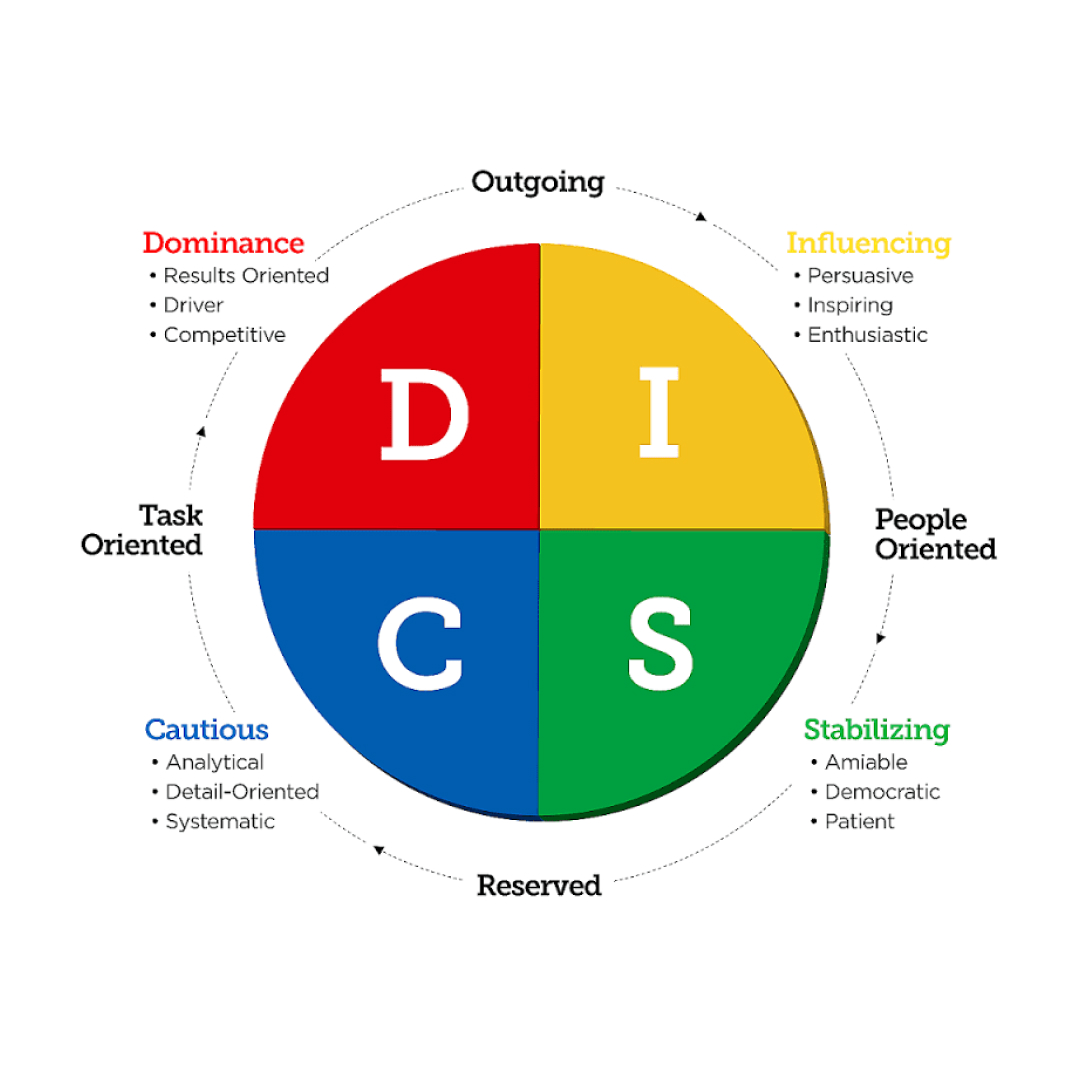
D Under Stress: The Bulldozer
The D-style's strength is decisiveness. Under stress, that becomes domination. They stop listening. They issue directives. They confuse urgency with leadership. Teams learn to stop pushing back, which means the D makes faster decisions with less information. Exactly the opposite of what the moment requires.
The EQ intervention: Before deciding, ask one question. Any question. "What am I missing?" or "What would you do?" or "What's the risk I'm not seeing?" One question breaks the bulldozer pattern and signals to the team that input is still welcome.
I Under Stress: The Tornado
The i-style's strength is energy and optimism. Under stress, that becomes chaos. They generate ideas at machine-gun speed, jump between topics, and struggle to land on a single course of action. Their enthusiasm, usually an asset, becomes noise that exhausts the people around them.
The EQ intervention: Write it down. When you feel the spiral starting, grab a notepad or whiteboard. Externalize the thinking. This gives the i-style a visual anchor and gives the team something concrete to respond to instead of trying to catch ideas mid-air.
S Under Stress: The Ghost
The S-style's strength is stability. Under stress, they disappear. Not physically, but intellectually. They stop contributing in meetings. They agree with whatever is proposed to end the discomfort. They process everything internally and sometimes emerge days later with concerns that could have shaped the decision, if anyone had known to ask.
The EQ intervention: Schedule the debrief. S-styles often have the most thoughtful perspective in the room, but stress prevents them from sharing it in real time. After high-pressure meetings, send a follow-up: "I want your honest take. No rush, take until tomorrow." You'll get gold.
C Under Stress: The Fortress
The C-style's strength is rigor. Under stress, rigor becomes rigidity. They demand more data, refuse to commit until every variable is accounted for, and become increasingly critical of others' "sloppy" reasoning. They're not trying to slow things down. They're trying to feel safe by being certain. But certainty is a luxury stress doesn't afford.
The EQ intervention: Define the decision criteria upfront. "We need to decide by Friday. The criteria are X, Y, and Z. If we have 80% confidence on those three, we move." This gives the C-style a structured path to "good enough" instead of an open-ended pursuit of perfect.
Building EQ Into Your Team's Operating System
Individual awareness isn't enough. The strongest teams make emotional intelligence a team-level practice through their psychological safety norms and daily rhythms.
1. Stress Check-Ins (2 Minutes, Start of Every Standup)
Before diving into updates, go around the room: "On a scale of 1-5, what's your stress level today?" No explanations needed. Just the number.
This does two things. It gives the team data on each other's emotional state. And it normalizes talking about pressure instead of pretending everyone is always fine.
2. The "Style Flex" Retro
At the end of each sprint or project phase, add one question to your retrospective: "When did we flex our styles well this sprint? When did we fall into our stress patterns?"
This builds the team's collective EQ over time. It also reinforces that communication style awareness isn't a one-time workshop. It's an ongoing practice.
3. Manager Coaching on Style Flexibility
Managers should track their direct reports' stress patterns. Not to diagnose, but to adapt.
If you know your S-style report goes quiet under deadline pressure, you don't wait for the all-hands to ask their opinion. You pull them aside first. If you know your D-style report becomes abrasive when the board is circling, you help them prepare their ask instead of their demand.
This is what we mean by the culture of leadership at Level 4 of the Six Levels. It's not about one leader being smart. It's about every leader being adaptive.
The Compound Effect
Here's what I've learned from coaching hundreds of tech leaders: the teams that win aren't the ones with the best strategy. They're the ones that communicate clearly under pressure.
A team where every person understands their stress patterns. Where managers flex their style before the room breaks down. Where conflict is addressed in the language of styles, not blame.
That's emotional intelligence and DiSC working together. Not as a one-time assessment, but as a daily operating practice that compounds over months and years into something your competitors can't copy: a team that gets better under pressure instead of worse.
Want to assess your team's communication and emotional intelligence across all six levels? Take the Team Dynamics Assessment and see exactly where your team excels and where stress is eroding performance.
Frequently Asked Questions
Now that you have mastered how to manage conflict - what is your plan of action for making an impact with your team?
Now that you have mastered how to create an environment of empowerment via the 3-P's - what is your plan of action for making an impact with your team?
Developing Your Communication, Empathy and Emotional Intelligence skills is start. What is your plan of action for implementing your learnings within your your team?
Now that you understand the differences in these titles - what is your plan of action for what you learned?
Assessing your team's behaviors is a start - but do you have a plan of action for the results?
Now that you have mastered the art of decision making - what is your plan of action for making an impact with your team?
.png)
A DISC Behaviour Assessment is the best way to understand your team's personalities.
Each DISC Assessment includes a Self Assessment and DISC Style evaluation worksheet
.webp)


