


How to Build a High-Performing Team: The Six Levels Framework
Teams with high engagement are 23% more profitable than disengaged ones. Knowing that stat doesn't tell you how to build a high performing team. Most leaders are still guessing.
Every leader says they want a high-performing team. Almost none know what it actually requires.
They run a team offsite. They hire smarter people. They set OKRs and cross their fingers. Sometimes it works. Usually it's frustrating. The team that looked great on paper still moves slowly, argues in circles, and loses good people for reasons nobody quite understands.
Here's the thing: high-performing teams don't happen by accident. They're built. Deliberately. In a specific sequence.
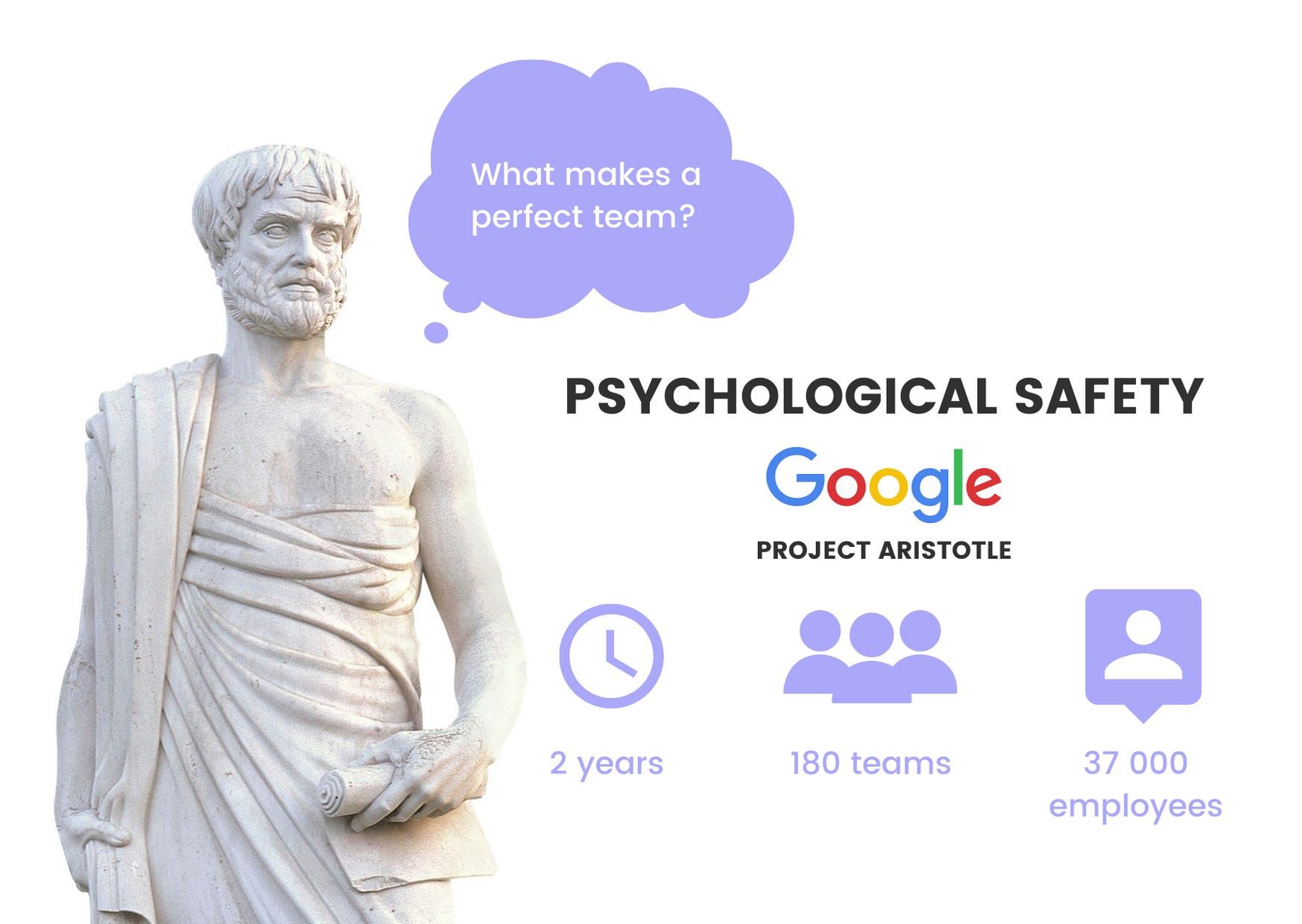
Google spent years studying 180 teams across their organization to figure out what separates great teams from average ones. What they found through Google's Project Aristotle surprised almost everyone. It wasn't the talent. It wasn't the incentives. It wasn't the strategy.
It was how the team made each other feel.
What the Research Actually Found
Google's Project Aristotle studied 115 engineering teams and 65 sales teams. They measured 250+ team attributes: education levels, tenure, personality types, management styles, co-location versus remote. They expected to find a magical formula involving the right mix of people.
What they found: the "who" barely mattered. The "how" mattered enormously.
Specifically, five factors predicted whether a team would perform at a high level:
Psychological safety wasn't just one of five factors. It was the foundation. Without it, the other four struggled to develop.
This is the most validated finding in organizational psychology of the last decade. And the broader trend is moving the wrong direction. Gallup's State of the Global Workplace report shows that worldwide employee engagement has fallen to 20%, down from its 2022 peak of 23%. Most teams are getting less engaged, not more. The ones bucking that trend share a pattern. Their leaders are deliberately building the conditions Project Aristotle identified.
The Problem With the Research
Project Aristotle is brilliant. And it leaves a critical question unanswered.
In what order do you build these things?
Knowing that high-performing teams need psychological safety, clarity, meaning, and impact is like knowing that fit people exercise, eat well, sleep enough, and manage stress. All true. Doesn't tell you where to start when you're overwhelmed and out of shape.
That's the gap the Six Levels of High-Performing Teams was built to fill. It's a sequential dependency framework. Each level must be established before the next one can hold.
You can't build empowerment before trust is established. You can't drive productive conflict before empowerment is in place. You can't create a culture of leadership before your communication is actually working.
Skip levels and you get teams that look functional and feel broken. They hit numbers for a quarter and fall apart under pressure. They say the right things in all-hands meetings and have the wrong conversations afterward.
The Six Levels: What They Are and Why the Order Matters
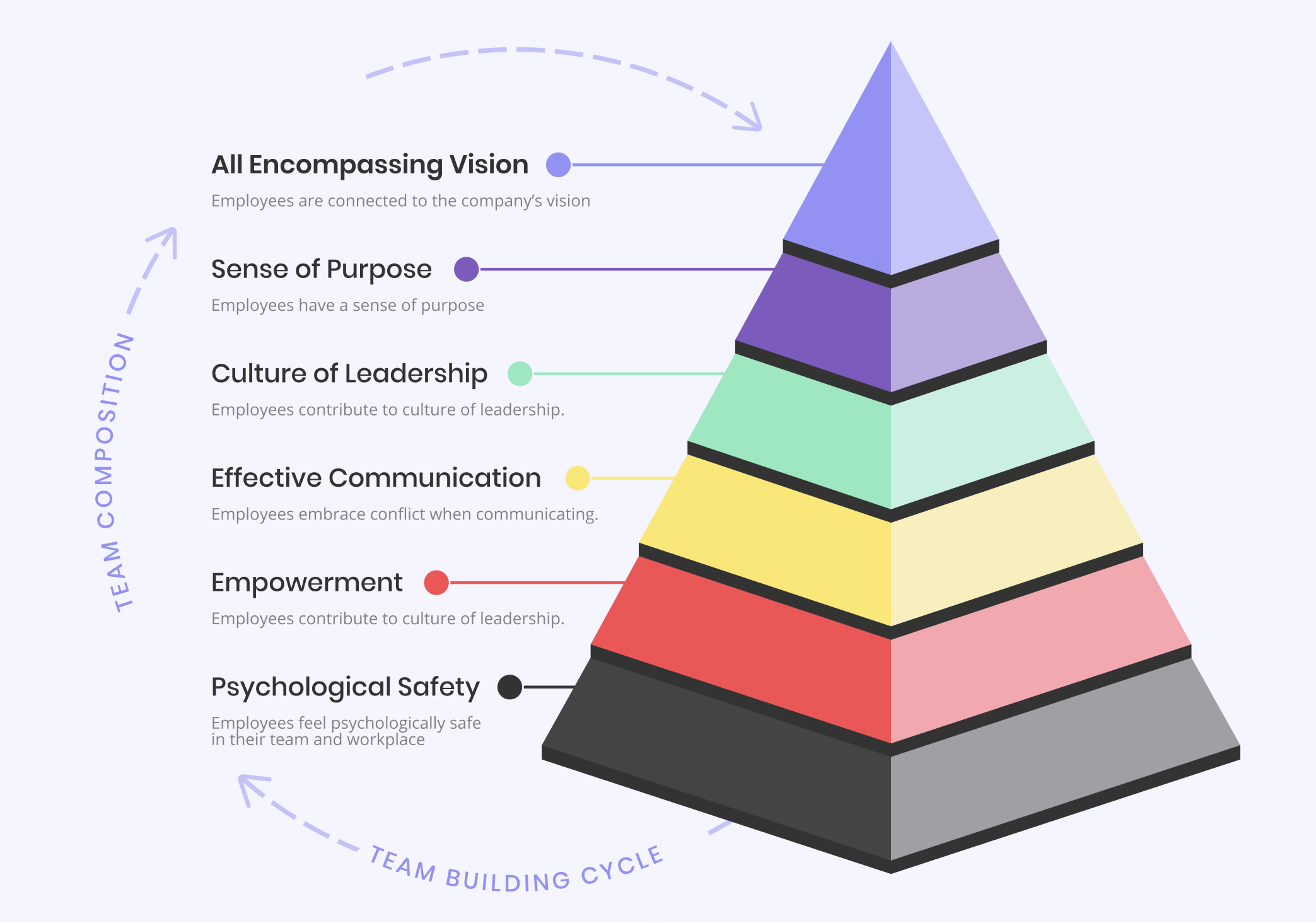
Level 1: Psychological Safety (The Foundation)
Everything starts here. Amy Edmondson at Harvard defines psychological safety as the belief that you won't be punished or humiliated for speaking up, for asking questions, raising problems, or admitting you don't know something.
Without it, nothing else works as intended. Ideas don't surface. Problems fester until they explode. Good people go quiet. You build a team operating at 60% of capacity because the other 40% feels too risky to show.
You can't coach psychological safety by telling your team to speak up. You build it by how you react when they do. Four behaviours shape it more than any others:
It sounds straightforward. It isn't easy. And it's the most important work you can do as a leader. If you want to go deeper on building psychological safety on tech teams, we have an entire workshop built around it.
Level 2: Empowerment
Once people feel safe, they need to feel trusted.
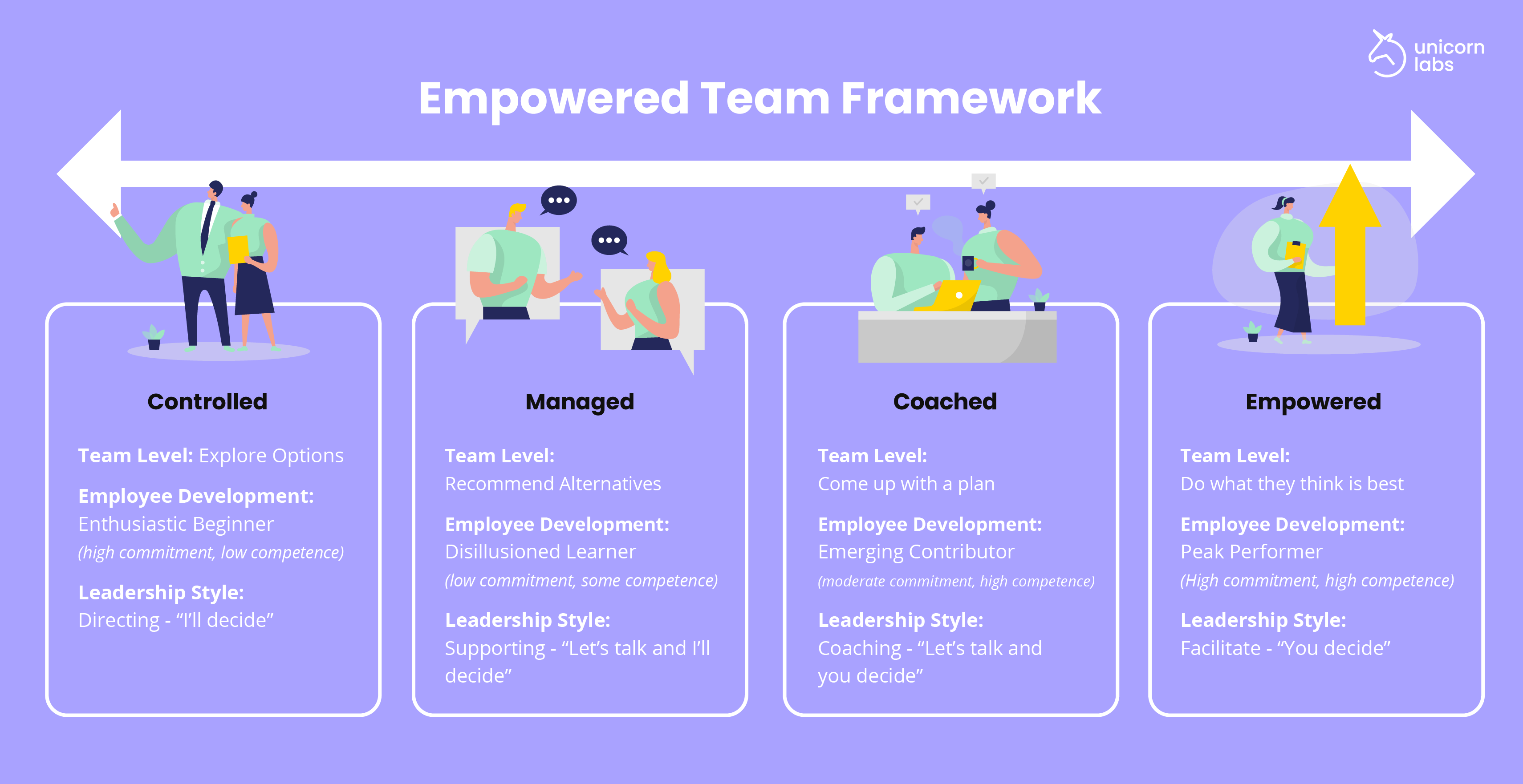
Empowerment runs on a spectrum: Controlled → Managed → Coached → Empowered. Most tech companies talk about autonomy while practicing control. Not because they're bad leaders, but because the transition from "doing" to "enabling" is one of the hardest shifts in a leader's career.
The clearest signal that empowerment is broken: your team can't move without your approval. Decisions pile up. Meetings exist to get your sign-off. Your calendar is everyone else's bottleneck.
Structural tools help: OKRs that give teams ownership of outcomes not just tasks, clear RACI maps so people know who decides what, deliberate delegation of whole problems rather than slices of work. But the biggest empowerment unlock is trust in the person, not just the process. Your team won't own their work until they believe you trust them enough to let them fail occasionally.
Level 3: Effective Communication and Productive Conflict
This is where most teams stall. And it's the tipping point for everything that follows.
MIT research identified three communication factors that predict team performance above all others: Energy (the quality of individual interactions), Engagement (the breadth of who participates), and Exploration (how much the team seeks input outside the group). Together they shape the team's communication climate.
Most teams have low exploration. The same voices. The same patterns. The same ideas in different slides.
Productive conflict is not fighting. It's the discipline to disagree clearly, debate honestly, and decide together. Patrick Lencioni's research shows that teams who avoid conflict don't have less of it. They have more, driven underground where it corrodes culture slowly.
Conflict resolution on tech teams requires specific skills around how different people process disagreement. An engineer who goes quiet in a contentious meeting isn't disengaged. They may be processing differently. A founder who talks over people in strategy discussions isn't disrespectful. They're wired to move fast. Understanding those differences turns friction into productivity.
Level 4: Culture of Leadership
At this level, the goal shifts from building a strong team to building a team that creates more leaders.
Goleman's research on leadership styles shows coaching is the most impactful style for long-term performance. And the least-used one. Leaders default to telling because telling is faster. Coaching is slower in the short run and dramatically faster across years.
The question Michael Bungay Stanier recommends asking instead of giving advice: "What's the real challenge here for you?" Seven words that signal you're here to develop people, not just direct them.
At Level 4, managers stop being the answer machine and start being the question machine. That shift compounds. Every person who learns to lead becomes a multiplier. That's the 1+1=3 effect.
Level 5: Sense of Purpose
Motivation research from Neel Doshi and Lindsay McGregor identifies six reasons people work. Three are direct: Play (you love the work itself), Purpose (you believe in what the work creates), and Potential (the work helps you grow). Three are indirect: economic pressure, emotional pressure, inertia.
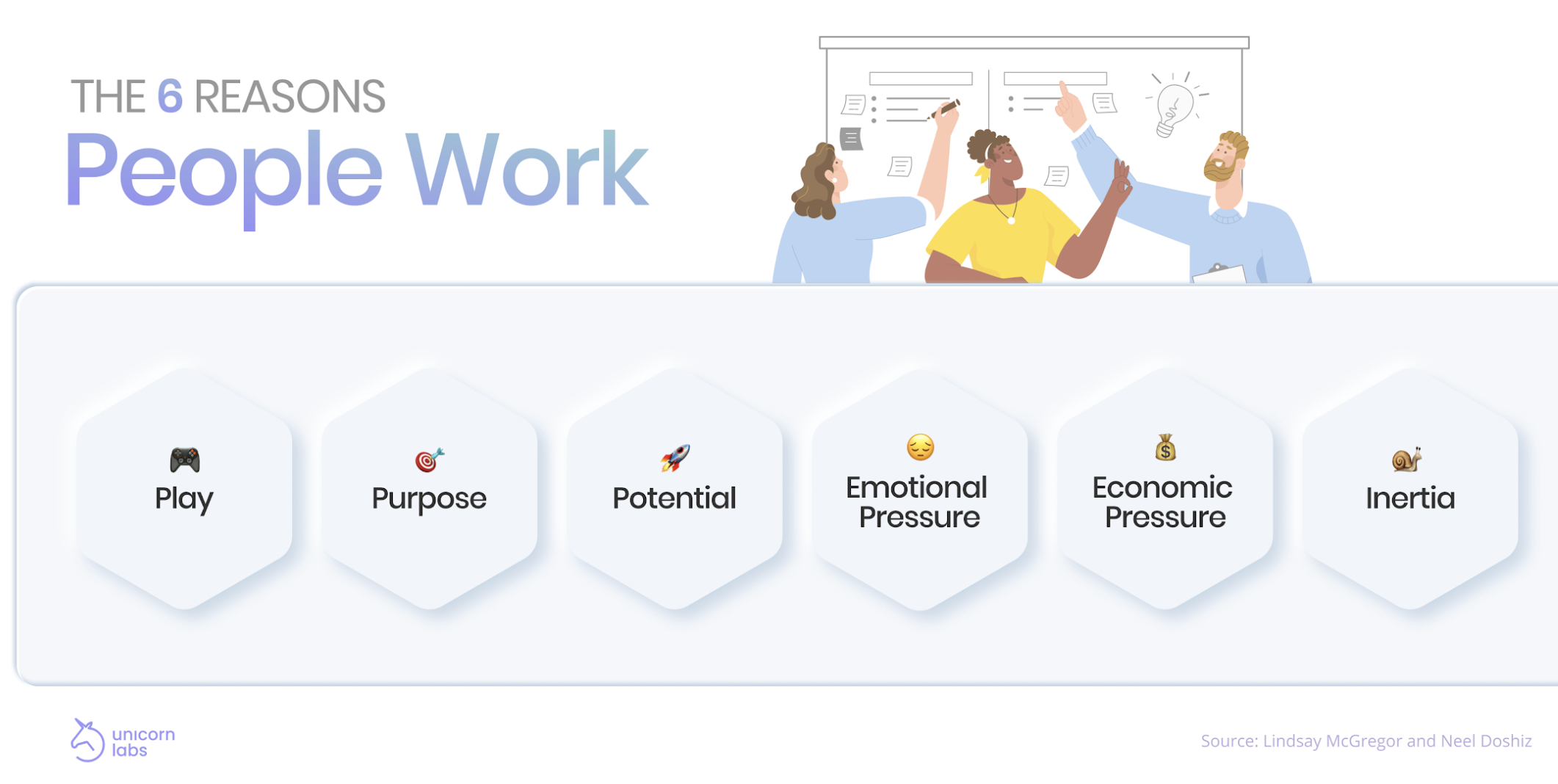
High-performing teams run on direct motives. Struggling teams run on indirect ones.
The leader's job at Level 5 is to connect daily work to the direct motives. Not through a vision speech once a year, but through how you recognize effort, how you frame projects, and how frequently you make the "why" visible. Gallup research shows that employees who strongly agree their supervisor holds them accountable for performance are 2.5x more engaged than those who don't. Accountability and meaning are linked: when work matters, being held to a standard feels like respect, not punishment.
If the lines between roles are blurry at your company, start with the difference between a supervisor, manager, and leader.
Level 6: All-Encompassing Vision (The Pinnacle)
At the top, the team has moved beyond alignment into something closer to attunement. An almost intuitive synchrony about where the team is going and why every decision serves that direction.
Jim Collins' BHAGs (Big Hairy Audacious Goals) capture this: a shared future state specific enough to direct daily decisions, ambitious enough to outlast any individual's tenure.
Most companies have a vision statement. Few have a living vision. One that shows up in hiring decisions, product tradeoffs, and the conversations that happen when no one's watching.
Building to Level 6 is rare. It's also what separates the companies people remember from the ones they forget.
How to Actually Use This Framework
The most common mistake: trying to work on all six levels simultaneously.
Don't do that. Start with an honest assessment of where your team actually is.
Signs your team is stuck at Level 1 (Psychological Safety):
Signs you're stuck at Level 2 (Empowerment):
Signs you're stuck at Level 3 (Communication):
Once you know where you're stuck, intervene at the right level. Putting a Level 4 coaching program in place for a team that doesn't yet have Level 1 safety is like building the second floor before the foundation is set.
The leadership development ROI compounds when you invest in the right level at the right time. It requires knowing where your team actually stands.
What Unicorn Labs Knows From 900+ Team Assessments
Our Team Assessment (TDA) has now run across 900+ respondents in scaling tech companies. The data tells a consistent story.
Teams score highest on psychological safety and vision. The gap between those two levels? Everything in the middle, empowerment, communication, leadership culture, and purpose, tends to be where things break down.
Communication is the most volatile level. It's where the highest-performing teams separate themselves most dramatically from average ones. And it's where most organizations invest the least.
The new manager training program failures we see most often trace back to Level 3: managers who have the knowledge but lack the communication skills to build trust and navigate productive disagreement with their teams.
Building those skills at the right level and in the right sequence is what separates the Davids from everyone else.
How Long Does This Actually Take?
The Bamboo Tree grows underground for four years before it breaks the surface. Then it shoots up 90 feet in six weeks.
High-performing teams work the same way. The early work, building safety, empowerment, and communication, feels slow. You're not always sure it's working. Then one day the team ships something remarkable, navigates a crisis without losing anyone, or consistently outperforms a competitor with twice the resources.
That's the 1+1=3 moment. The payoff on the foundation you built when no one was watching.
High-performing teams aren't built quickly. But they are built deliberately. In a specific sequence. By leaders who understand that the most important work isn't visible on any dashboard.
Start at Level 1. Build the foundation. And don't skip levels.
Want to know which level is holding your team back? The Six Levels eBook gives you the full framework, team assessment questions for each level, and a practical playbook for building from the foundation up. Download it free
Frequently Asked Questions
Now that you have mastered how to manage conflict - what is your plan of action for making an impact with your team?
Now that you have mastered how to create an environment of empowerment via the 3-P's - what is your plan of action for making an impact with your team?
Developing Your Communication, Empathy and Emotional Intelligence skills is start. What is your plan of action for implementing your learnings within your your team?
Now that you understand the differences in these titles - what is your plan of action for what you learned?
Assessing your team's behaviors is a start - but do you have a plan of action for the results?
Now that you have mastered the art of decision making - what is your plan of action for making an impact with your team?
.png)
A DISC Behaviour Assessment is the best way to understand your team's personalities.
Each DISC Assessment includes a Self Assessment and DISC Style evaluation worksheet
.webp)


