
Management

Management Training for Tech Companies: A Buyer's Guide

Table of Contents:

You’ve typed “management training for tech company” into Google, and now you’re staring at forty vendors who all promise the same thing. Engaging content! Proven curriculum! Happy managers! How do you tell the program that changes behaviour from the one that produces nice certificates and nothing else?

The baseline you’re buying against is uncomfortable. In the UK, 82% of people who step into management have had no formal management training (CMI/YouGov, 2023). When companies do train them, little of it transfers: only 12% of employees apply new skills from L&D programs to their jobs, according to a survey cited in Harvard Business Review. And what doesn’t get practised fades fast. In a 1979 Xerox sales-training study, 87% of the new skill was gone within a month when no coaching followed. Most programs are built to be liked. Few are built to stick.

The baseline you're buying against

82%

of people who step into management in the UK have had no formal management training

CMI/YouGov, 2023 (UK)

12%

of employees apply new skills from L&D programs to their jobs

Survey cited in Harvard Business Review

87%

of the new skill was lost within a month when no coaching followed

Xerox sales-training study, 1979

This guide gives you the evaluation framework we’d want if we were sitting in your chair: which formats work, the red flags that predict wasted budget, the exact questions to ask vendors, and how to prove ROI to your CFO. (Yes, that includes how to evaluate our own new manager training program. Hold us to the same standard.)

‍

Why the Stakes Are Higher in Tech

Manager quality sits underneath almost everything else on a team. Gallup estimates that managers account for at least 70% of the variance in engagement across business units. In tech, that effect compounds for three reasons.

First, the promotion pattern. Your managers were your best engineers. The habits that made them great ICs now work against them: depth, autonomy, solo output. We’ve written about this pattern in our manager competency framework for tech companies.

Second, the talent math. Laszlo Bock, who ran People Operations at Google, argues in Work Rules! that performance follows a power law: a small group of top performers creates most of a team’s value. So when a bad manager pushes out one senior engineer, you lose far more than one seat on the org chart.

Third, the market. Perceptyx found that workers with “poor” or “fair” managers are five times more likely to leave within a year than those with “excellent” managers. Your competitors are one recruiter InMail away.

So the decision in front of you is what to buy, and how to avoid the wrong thing. The demand is real: nearly 4 in 10 leaders say they don’t get enough coaching from their own manager, according to DDI. The training industry is happy to sell you volume instead of change.

‍

The Four Formats (and What Each Actually Delivers)

Most vendors sell one of four formats. Each has a legitimate use. Problems start when a vendor sells you their format as the answer to every problem.
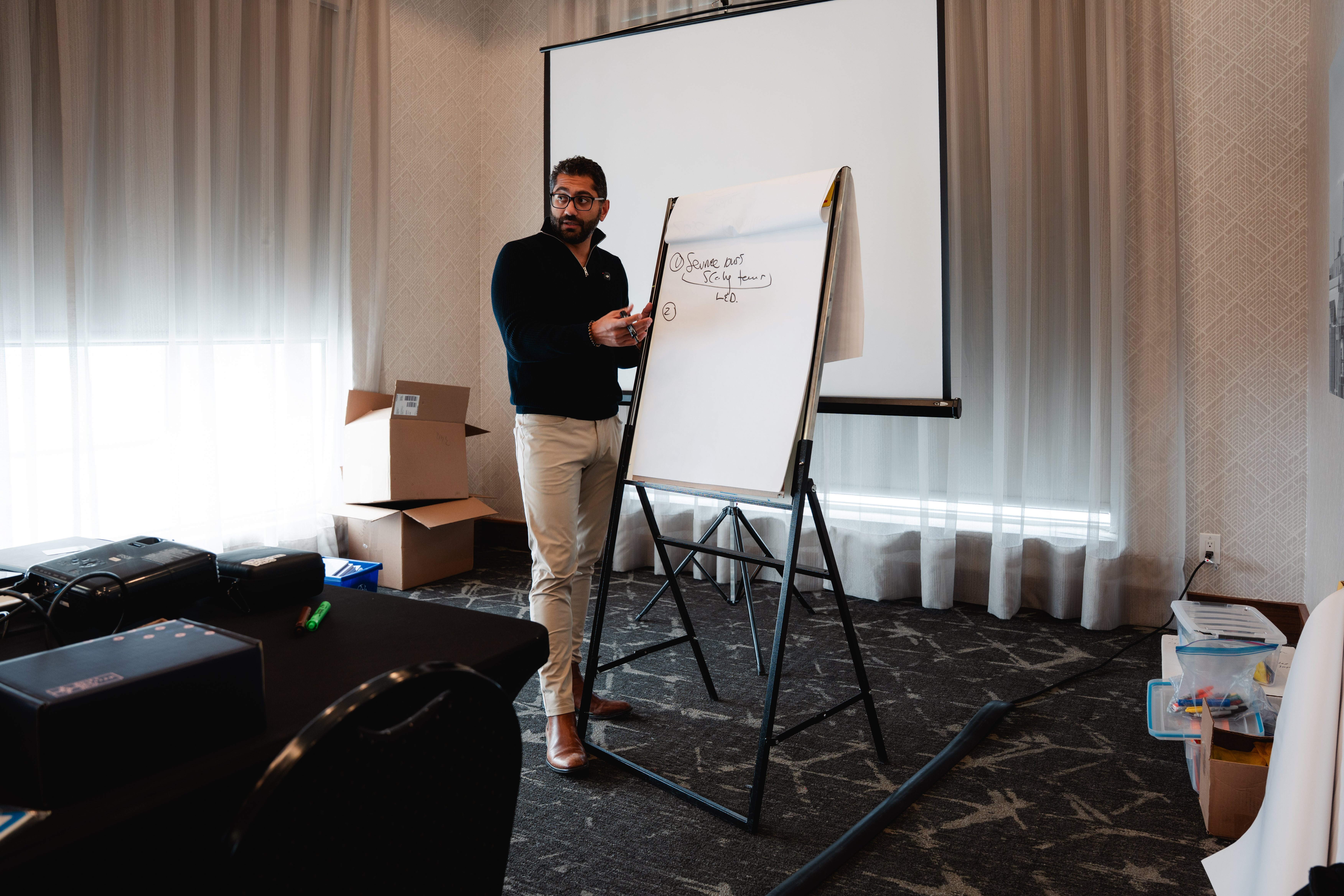
Fahd Alhattab writing on a flip chart during a leadership workshop, mapping out ideas in marker

1. Self-paced online courses

Cheap, scalable, and mostly ignored. Completion rates for optional online courses are famously low, and the application gap hits hardest here because nobody practises anything. Use them for pre-work. Never as the core fix.

‍

2. One-off workshops

A single day on feedback or delegation. Good for energizing a specific skill, and a skilled outside voice can shift how a team talks. But without follow-up, you’re renting energy for a day. Remember the Xerox finding: when no coaching followed, most of the new skill was gone within a month.

‍

3. Cohort-based programs

A group of managers, usually 10 to 30, moving through live sessions over 8 to 16 weeks, with practice between sessions. This format builds in the two things that make training stick: spaced reps and peer pressure. It costs more per head. It’s also the only format we’ve seen reliably change Monday-morning behaviour.

‍

4. 1:1 coaching

The highest-touch option. Best for senior leaders or high-stakes transitions. Powerful, but hard to scale across a manager population and hard to standardize.

Four formats, one spine

The appendix

Self-paced online courses

Best for
Pre-work before live sessions
What it delivers
Cheap, scalable content
Watch for
Low completion, and nobody practises
Short-term lift

One-off workshops

Best for
Energizing one specific skill
What it delivers
A shared moment and a fresh outside voice
Watch for
Without follow-up, most of the skill fades within a month
The spine

Cohort-based programs

Best for
Changing behaviour across a manager population
What it delivers
Spaced reps and peer pressure over 8 to 16 weeks
Watch for
A higher cost per head
The amplifier

1:1 coaching

Best for
Senior leaders and high-stakes transitions
What it delivers
High-touch support tailored to one leader
Watch for
Hard to scale and hard to standardize

Our take: cohort training with live practice is the spine. Coaching is the amplifier. Online content is the appendix. If a vendor leads with the appendix, keep walking.

‍

Seven Red Flags That Predict Wasted Budget

You can disqualify most vendors in one call by watching for these:

Disqualify most vendors in one call

  1. 01They lead with the content library.

    Hours of video and a slick learning platform are the appendix. Ask what happens live, and what happens between sessions.

  2. 02Success means completion rates and smile sheets.

    Finished modules and happy participants tell you nothing about Monday morning. Ask which behaviours they measure, and how.

  3. 03One format fixes everything.

    If every answer is a workshop, or a course, or a coach, you're getting their catalogue instead of a diagnosis.

  4. 04Nothing happens between sessions.

    No practice on real work, no peer debrief, no check-in. That gap is where most of the learning disappears.

  5. 05No baseline before day one.

    A vendor who doesn't want to measure where your teams start can't show you what moved.

  6. 06They ask nothing of your exec team.

    If the people at the top don't model the behaviour, your managers notice. A vendor who never raises sponsorship is selling seats.

  7. 07Generic scenarios.

    Role plays set in a retail store or a call centre won't land with engineers. Ask to see the scenarios they'd run with your teams.

If you’re specifically building the case for first-time managers, our new manager training guide for HR leaders goes deeper on program design for that group. If you’re comparing named providers, our 2026 comparison of leadership development programs for tech startups lines up eight of them. This guide stays focused on how to evaluate any vendor across your whole manager population.

‍

The Ten Questions to Ask Every Vendor

Put these in your RFP or read them off in the sales call. The answers separate education businesses from behaviour-change businesses.

Paste these into your RFP

  1. What will my managers do differently 90 days after the program ends?

    Listen forSpecific behaviours. A list of topics is a warning sign.

  2. How do you measure that change?

    Listen forTeam-level data from before and after the program.

  3. What happens between live sessions?

    Listen forPractice on real work, followed by a debrief.

  4. How do you set a baseline before we start?

    Listen forA clear method. If they can't describe one, they can't prove anything later.

  5. How do you adapt scenarios for engineering and product teams?

    Listen forAn example they've used with a tech company.

  6. Who will run the sessions, and have they managed people themselves?

    Listen forPeople in the room who've done the job.

  7. How do you group cohorts?

    Listen forSeparate conversations for first-time managers, experienced managers and managers of managers.

  8. What do our managers' own managers do during the program?

    Listen forA real role. If the answer is nothing, the new habits won't survive the first busy quarter.

  9. Can we speak to a client 12 months after their program ended?

    Listen forA yes. Anyone can produce a happy reference from week two.

  10. What do you need from our executive team?

    Listen forSpecific commitments, and a willingness to tell you to wait if you can't make them.

Question ten is the one we’d push hardest on. Managers copy what they see above them. If your exec team won’t commit to modelling the same behaviours, hold the budget until they will. And get your CEO into the room for the kickoff. Their presence says more about sponsorship than any launch email.

‍

Making the Business Case: What to Show Your CFO

Your CFO doesn’t buy “better managers.” They buy retention math and productivity math.

The retention case writes itself from public data. Gallup estimates that replacing an employee costs one-half to two times their annual salary. In the same research, 52% of people who quit said their manager or organization could have done something to keep them. Model one scenario: if training prevents just two regretted exits next year, what’s the saving against the program cost? In our experience, that single line item often pays for the program. To run the numbers for your own teams, try our Manager Debt Calculator.

The retention math

½ to 2×

a person's annual salary is what it costs to replace them

Gallup, 2019

52%

of people who quit said their manager or organization could have done something to keep them

Gallup, 2019

What do regretted exits cost you?

Estimated replacement cost

$150,000 to $600,000

Uses Gallup's range of one-half to two times annual salary per exit. Treat it as an illustration.

Run the full Manager Debt Calculator

The output case is bigger but slower to prove. The public studies tying training spend to income per employee are old and correlational, so don’t lean on them. Anchor instead on your own baseline: engagement scores, regretted attrition, internal moves, and ramp time for new hires. If your CFO thinks in revenue per employee, start there.

Then measure like you mean it:

Measure like you mean it

  1. Before kickoff

    Baseline engagement, regretted attrition by manager, internal moves, and a team diagnostic score such as our Team Dynamics 360.

  2. At 90 days

    Rerun the team diagnostic and compare. This is your early signal that behaviour is changing on real teams.

  3. At 6 months

    Compare regretted attrition and internal moves on trained managers' teams against the baseline.

Skip completion rates. They tell you who showed up. Nothing more.

For the full budget-defence playbook, including how to translate manager development into numbers a CFO will accept, see our guide to leadership development ROI.

‍

Your Move This Week

Three concrete steps before you talk to a single vendor:

  1. Map your manager population. How many first-timers, how many experienced, how many managing managers? Fifteen minutes with your HRIS. This shapes format and cohort design more than any vendor pitch.
  2. Pull your regretted-attrition list from the last 12 months. Note which managers those people reported to. That pattern is your business case, and it tells you which cohort goes first.
  3. Write your success metric before the first sales call. One sentence: “In 12 months, we will see X move from A to B.” If you can’t write it, you’re not ready to buy, and a good vendor will help you write it before taking your money.

Buying management training for a tech company isn’t really a procurement decision. It’s a bet on where your next round of retention, velocity, and culture problems will come from. The vendors who deserve your budget are the ones who treat it that way.

Want to pressure-test your shortlist, or ours? Book a program fit call and we’ll walk through your manager population, your gaps, and whether our cohort-based program is honestly the right fit.

Pressure-test your shortlist

Book a program fit call

Bring your manager map and your regretted-attrition list. We'll tell you honestly whether our cohort-based program fits.

Frequently Asked Questions:

Costs vary widely by format and provider. Self-paced courses cost the least per manager, cohort programs sit in the middle, and 1:1 coaching costs the most. For current benchmarks, see our breakdown of what tech companies spend on leadership development. Before you compare quotes, run the retention math: Gallup estimates that replacing one employee costs one-half to two times their annual salary. Judge price per behaviour changed, not per seat.

Long enough for managers to practise between sessions. Cohort programs typically run 8 to 16 weeks, with live sessions spaced out and real-work assignments in between. Spacing matters because skills fade fast without reinforcement. In a 1979 Xerox sales-training study, 87% of the new skill was lost within a month when no coaching followed. Managers change through reps, so pick a structure that builds them in.

The basics of feedback, delegation, and trust are universal. The failure modes in tech are specific. Tech companies tend to promote their best engineers into management with little or no training. In the UK, 82% of people who step into management have had no formal management training (CMI/YouGov, 2023). Engineering teams skew autonomous and allergic to corporate content. And if performance follows a power law, as Laszlo Bock argues in Work Rules!, losing one top engineer to a bad manager costs far more than one seat. Training that works in tech uses engineering-flavoured scenarios and treats managers as skeptical adults, not workshop hostages.

Set a baseline first, then compare 90-day and 6-month movement on team-level metrics: regretted attrition, engagement, internal moves, and a team diagnostic score. Gallup estimates that managers account for at least 70% of the variance in engagement, so team-level movement is the honest signal. Completion rates are noise. A team diagnostic such as our Team Dynamics 360, run before and after, lets HR leaders show their CFO score movement instead of quotes.

Buy the spine, build the context. External programs bring tested curriculum and practice structures that internal L&D teams rarely have capacity to build. Internal teams bring company-specific scenarios and executive sponsorship. The hybrid we recommend: an external cohort program, co-designed scenarios, and internal skip-level rituals that keep the new habits alive after the program ends.

‍

Now that you have mastered how to manage conflict - what is your plan of action for making an impact with your team?

Now that you have mastered how to create an environment of empowerment via the 3-P's - what is your plan of action for making an impact with your team?

Developing Your Communication, Empathy and Emotional Intelligence skills is start. What is your plan of action for implementing your learnings within your your team?

Now that you understand the differences in these titles - what is your plan of action for what you learned?

Assessing your team's behaviors is a start - but do you have a plan of action for the results?

Now that you have mastered the art of decision making - what is your plan of action for making an impact with your team?

Download your free leadership guide that outlines the 6 necessary steps you need to acheive in order to develop a high performing team (in weeks, not months).  
Help your managers improve their managing of communication, collaboration and conflict. Download your free leadership guide that outlines the 6 necessary steps you need to achieve in order to develop a high performing team (in weeks, not months).
Download your free leadership guide that outlines the 6 necessary steps you need to acheive in order to develop a high performing team (in weeks, not months).  
Get My Free Leadership Guide Now

A DISC Behaviour Assessment is the best way to understand your team's personalities.

Start by understanding your own behaviour tendencies with a DISC assessment. Learn more about how a DISC Assessment will improve your potential as a leader!

Each DISC Assessment includes a Self Assessment and DISC Style evaluation worksheet
Bill Gates Training Sidebar
Bill Gates Leadership

Curious how to develop into a transformational leader like Bill Gates?

Start by accessing our FREE Training video that outlines six simple steps for creating an environment that will transform YOU, and YOUR TEAM, into Unicorn leaders.

Leadership Training Ad - Sidebar
Leadership Training

Are you ready to transform from just a manager into a Unicorn Leader?

You can access our FREE training that will give you clarity on how to create a successful team in just six steps.

Leadership Training Ad - Sidebar
Leadership Training

Curious on some tips for transforming your managers into leaders?

Access our BEST, free training video that HR leaders are using to inspire real conversations with their managers.

In less than 25 minutes, you can gain clarity on how to turn your teams into centers for growth.

Access FREE Leadership Training Now
Career Conversations Sidebar
Career Conversations Guide

Is Your Company Culture Stuck In A Rut? Sometimes creating an environment for continuous learning can make a huge difference.

We created the best guide for having career development conversations with your teams.

Increase motivation and retain your top talent by following these simple steps.

EQ Leadership Sidebar
EQ Leadership Image

Did you know that EQ is more valuable to a leader than IQ?

We created the BEST, FREE training video to help managers map out a clear path for transformation into a Unicorn Leader.

Are you ready for your leadership transformation?

Access FREE Leadership Training Now
Leadership Workshop Sidebar
Leadership Workshop Image

Empowering your team to make decisions is just the start. Are you also supporting the other key elements for a high-performing team?

An investment in your team's development is an investment in your company's ability to effectively scale.

We've created an experiential, virtual workshop that focuses on developing teams into scalable engines of growth.

Interested in customizing a workshop for your team?

Learn More About The Leadership Workshop

Related posts