
Management

OKR Examples for Startups: 24 Key Results by Team

Table of Contents:

It’s 4pm on planning day, and your engineering lead is staring at a blank OKR template. They know the theory. What they’ve never seen is a good one for a team like theirs.

A good startup OKR pairs one plain-language objective with three to five key results that measure outcomes, each with a number and one owner. For example: Get new users to value in their first week, measured by raising week-1 activation from 28% to 42% and cutting time-to-first-value from three days to four hours. This post gives you 24 key results like that for company, engineering, product and go-to-market teams, plus the rewrites that teach the pattern.

Most examples online don’t help, because they’re either Google-scale or so generic they could belong to any company. If you’re setting up the whole system, start with the ultimate guide to OKRs and our post on the operating cadence startups need after Series A. This one is the examples.

‍

Why Do Most Startup OKRs Point Nowhere?

Goals that point nowhere aren’t new. When Donald Sull and Rebecca Homkes surveyed more than 11,000 managers at over 400 companies, only a third of senior managers could name their firm’s top three priorities. The people doing the work feel it too. Among Gen Z and younger millennial workers in the US, the share who strongly agree they know what’s expected of them at work fell from 51% in 2020 to 42% in 2025, according to Gallup.

Our own data says the same. Across our Team Dynamics Assessment database, the statement teams agree with least is “Team does not feel like they are constantly treading water.” Most teams are working hard and can’t tell whether it’s moving anything.

OKRs are supposed to fix that. Most startup OKRs don’t, for two reasons.

The key results describe activity. In the OKR drafts we see from scale-up leadership teams, the same problem shows up again and again. “Ship the new onboarding flow.” “Hire two AEs.” “Launch the partner program.” Those are projects. You can finish every one of them and still have a worse business than you started with. A key result should measure the change the work causes.

There are too many of them. Nine objectives and thirty key results, so everyone feels covered. Nobody can hold that in their head, so nobody steers by it. The cap we use in Founder Operating System engagements is three to five objectives per team, with three to five key results each, and only one to three company objectives before you’ve found product-market fit. Google’s own guide to OKRs lands in the same place: three to five objectives, with around three key results each.
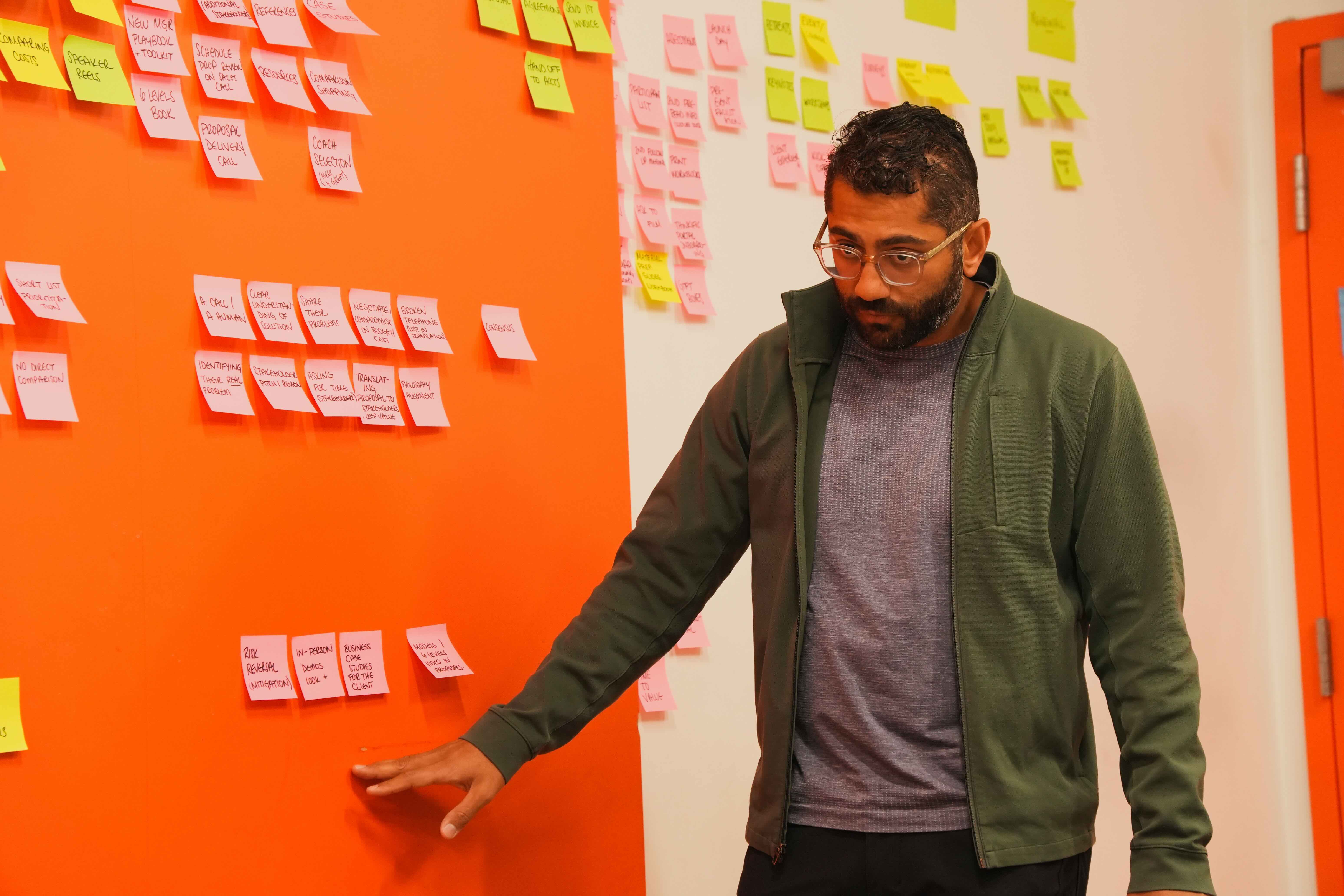
Fahd Alhattab pointing to a wall of coloured sticky notes mapping a sales and customer journey during a Unicorn Labs strategy workshop

‍

What Makes a Good Startup OKR?

A strong objective is qualitative, ambitious and time-boxed. It answers “where are we going this quarter?” in words a new hire would understand. A strong key result is a number that measures an outcome. It answers “how will we know we got there?”

Run three tests on every key result you draft:

  • The finish-line test. Could you hit it and the business be no better off? Then it’s an activity. Move it to the initiatives list and ask what it’s supposed to change.
  • The dashboard test. Can you read it off a dashboard every week or month, without a debate about what counts? If not, rewrite it until you can.
  • The Power of One check. Does one named person own it? Co-ownership is a polite way of saying nobody owns it.

Check your key result

Type one key result and its owner. The checker runs the three tests as you type. Or start from an example.

  • The finish-line testWaiting

  • The dashboard testWaiting

  • The Power of One checkWaiting

A quick check on wording, so use your judgment too. Nothing you type is saved or sent anywhere.

Ownership matters more than it looks. Shared goals with fuzzy owners are how founder bottlenecks survive an OKR rollout intact: everything still escalates to the CEO, because nobody else clearly owns the result.

‍

What Do Good OKRs Look Like for Each Team?

Adapt the numbers to your stage and your model. Copy the structure, then argue about the targets. Hold your own team’s goal sheet next to these as you read.

OKR examples by team

Company-level OKR examples

ObjectiveGrow without burning the runway

  1. Grow new ARR from $400K to $600K per quarter

    Owner: CRO

  2. Improve net revenue retention from 96% to 105%

    Owner: VP Customer Success

  3. Hold the burn multiple under 1.8 while doing both

    Owner: CFO

ObjectiveBecome the obvious choice in our target vertical

  1. Lift win rate against our top competitor from 34% to 50%

    Owner: VP Sales

  2. Grow inbound demo requests from 90 to 150 per month

    Owner: VP Marketing

  3. Land 8 referenceable customers in the target vertical

    Owner: VP Customer Success

Engineering OKR examples

ObjectiveMake the platform boringly reliable

  1. Cut P1 incidents from 6 to 2 per month

    Owner: Platform lead

  2. Reduce median deploy-to-production time from 4 days to 1

    Owner: VP Engineering

  3. Bring uptime from 99.5% to 99.9%

    Owner: Platform lead

ObjectiveMake shipping fast and safe for every engineer

  1. Reduce build time from 25 minutes to 8

    Owner: Developer experience lead

  2. Cut bugs older than 90 days from 240 to 60

    Owner: Engineering manager

  3. Raise test coverage on the billing service from 45% to 80%

    Owner: Billing team lead

There's no "ship project X" in either set. Projects live on the roadmap, and the OKR measures what shipping them is supposed to change.

Product OKR examples

ObjectiveGet new users to value in their first week

  1. Raise week-1 activation from 28% to 42%

    Owner: Growth PM

  2. Cut median time-to-first-value from 3 days to 4 hours

    Owner: Onboarding PM

  3. Improve day-30 retention from 22% to 33%

    Owner: Head of Product

ObjectiveTurn single users into team accounts

  1. Grow accounts with 5+ active users from 18% to 30%

    Owner: Head of Product

  2. Lift in-app upgrade conversion from 2.1% to 4%

    Owner: Monetization PM

  3. Drive 25% of new signups from in-product invites

    Owner: Growth PM

Go-to-market OKR examples

Sales objectiveBuild a pipeline we can forecast with confidence

  1. Grow qualified pipeline from 3x to 4.5x of quota

    Owner: VP Sales

  2. Raise SQL-to-close conversion from 18% to 25%

    Owner: Sales manager

  3. Cut the average sales cycle from 62 days to 45

    Owner: RevOps lead

Marketing objectiveMake marketing a cheaper source of growth

  1. Grow organic signups from 120 to 250 per month

    Owner: Content lead

  2. Lift email-sourced revenue from 8% to 15% of new ARR

    Owner: Lifecycle marketing lead

  3. Bring blended CAC payback from 19 months to 13

    Owner: VP Marketing

Adapt the numbers to your stage and your model. The structure is the part to copy.

‍

Bad vs Good: Three Rewrites That Teach the Pattern

Bad vs good: three rewrites

Bad: an activityGood: an outcomeWhy the rewrite works
Launch the new websiteRaise visitor-to-demo conversion from 1.2% to 2.5%The launch is the tactic. The conversion is what you're paying it to produce.
Hire 4 engineersIncrease shipped roadmap points per sprint from 30 to 50 by end of quarterHiring is an input. The output is what the hires should change.
Improve team communicationCut decision turnaround, from request to decision, from 9 days to 3It measures the behaviour better communication is supposed to produce.

The pattern: keep the activity on your initiatives list, and make the key result the change it should cause.

Bad: “Launch the new website.” Good: “Raise visitor-to-demo conversion from 1.2% to 2.5%.” The launch is the tactic, and the conversion is what you’re paying it to produce.

Bad: “Hire 4 engineers.” Good: “Increase shipped roadmap points per sprint from 30 to 50 by end of quarter.” Hiring is an input. If four hires don’t change your output, the quarter added cost without adding capacity.

Bad: “Improve team communication.” Good: “Cut decision turnaround, from request to decision, from 9 days to 3.” Vague culture goals get real when you measure the behaviour they’re supposed to produce. That’s the logic behind the Six Levels of High-Performing Teams: each level turns a fuzzy team quality into something you can see and score.

‍

How Do You Keep OKRs Alive After Planning Day?

Good examples die without a rhythm. Three meetings keep them alive, the same three we set up in Founder Operating System engagements:

The three-meeting rhythm

  1. Every weekWeekly check-in

    • 60 to 90 min
    • Monday morning

    The leadership team reviews the initiatives behind each key result and works the issues list. Off-track items get the discussion time.

  2. Every monthMonthly scorecard

    • 75 min
    • Last Friday

    Each owner walks through the trend on their numbers. The trend tells you more than this month's single number.

  3. Every quarterQuarterly reset

    • Half a day
    • First week of the quarter

    Score every key result, agree on what you learned, and set next quarter's OKRs.

Lock the day, time and attendees for all three before the quarter starts.

The weekly meeting is the one founders cancel when they get busy, and that’s the moment the system starts dying. Protect it.

For the full rhythm, including the annual offsite, see the operating cadence startups need after Series A. Before you lock next quarter’s sheet, check it against the six fatal OKR mistakes we see kill adoption.

‍

Copy the Structure, Argue About the Targets

Every example above follows the same rules: outcomes over activity, a short list, one owner per result, and a weekly meeting that keeps the scoreboard in front of everyone. Then score honestly at the end of the quarter. Google’s guide puts the sweet spot at 60 to 70% on stretch goals, and must-deliver key results should land at 100%.

Start with one team this quarter. Take its current goal sheet, run the three tests on every key result, and rewrite the ones that fail before the quarter starts.

Rolling out OKRs across the company? Book a strategy call and we’ll talk through the rollout with you. The Founder Operating System is how we install OKRs, scorecards and the meeting rhythm together.

Roll it out with your leadership team

Turn your OKRs into a rhythm your team keeps

We'll talk through your rollout with you, from the first drafts to the weekly check-in. The Founder Operating System is how we install OKRs, scorecards and the meeting rhythm together.

‍

‍

Frequently Asked Questions:

Three to five objectives per team, each with three to five key results, and fewer before product-market fit, when one to three company objectives is plenty. Google's guide to OKRs also suggests three to five objectives with around three key results each. A quick test: if your exec team can't recite the company objectives from memory, there are too many.

A KPI is a health metric you watch all the time, like uptime or churn. An OKR is a change you commit to making this quarter, like taking churn from 4% to 2.5%. KPIs tell you something broke, and OKRs organize the effort to fix or improve it. Keep a small KPI dashboard year-round and write OKRs only where you want movement.

Before product-market fit, mostly no. Company and team OKRs are enough, and individual ones tend to turn into task lists or performance-review ammunition. As you grow and add layers of managers, you can cascade OKRs to individuals, but keep them separate from performance reviews. Google's own guide says OKRs are not synonymous with performance evaluation.

About 0.6 to 0.7 on stretch key results, which is the sweet spot in Google's guide, and 1.0 on must-deliver ones. Decide which is which before the quarter starts. A team that hits 1.0 on every stretch goal aimed too low, and repeated scores of 0.2 mean the goals were fantasy or the quarter went sideways. What matters most is the conversation at the quarterly reset: what did we learn, and what does it change about next quarter?

Measure the behaviour the work should change. A platform team can measure deploy time and incident count. A people team can measure offer-accept rate, regretted attrition or time-to-productivity for new hires. If a team can't find any outcome number, ask a strategy question: what is the company buying with that team's quarter?

Now that you have mastered how to manage conflict - what is your plan of action for making an impact with your team?

Now that you have mastered how to create an environment of empowerment via the 3-P's - what is your plan of action for making an impact with your team?

Developing Your Communication, Empathy and Emotional Intelligence skills is start. What is your plan of action for implementing your learnings within your your team?

Now that you understand the differences in these titles - what is your plan of action for what you learned?

Assessing your team's behaviors is a start - but do you have a plan of action for the results?

Now that you have mastered the art of decision making - what is your plan of action for making an impact with your team?

Download your free leadership guide that outlines the 6 necessary steps you need to acheive in order to develop a high performing team (in weeks, not months).  
Help your managers improve their managing of communication, collaboration and conflict. Download your free leadership guide that outlines the 6 necessary steps you need to achieve in order to develop a high performing team (in weeks, not months).
Download your free leadership guide that outlines the 6 necessary steps you need to acheive in order to develop a high performing team (in weeks, not months).  
Get My Free Leadership Guide Now

A DISC Behaviour Assessment is the best way to understand your team's personalities.

Start by understanding your own behaviour tendencies with a DISC assessment. Learn more about how a DISC Assessment will improve your potential as a leader!

Each DISC Assessment includes a Self Assessment and DISC Style evaluation worksheet
Bill Gates Training Sidebar
Bill Gates Leadership

Curious how to develop into a transformational leader like Bill Gates?

Start by accessing our FREE Training video that outlines six simple steps for creating an environment that will transform YOU, and YOUR TEAM, into Unicorn leaders.

Leadership Training Ad - Sidebar
Leadership Training

Are you ready to transform from just a manager into a Unicorn Leader?

You can access our FREE training that will give you clarity on how to create a successful team in just six steps.

Leadership Training Ad - Sidebar
Leadership Training

Curious on some tips for transforming your managers into leaders?

Access our BEST, free training video that HR leaders are using to inspire real conversations with their managers.

In less than 25 minutes, you can gain clarity on how to turn your teams into centers for growth.

Access FREE Leadership Training Now
Career Conversations Sidebar
Career Conversations Guide

Is Your Company Culture Stuck In A Rut? Sometimes creating an environment for continuous learning can make a huge difference.

We created the best guide for having career development conversations with your teams.

Increase motivation and retain your top talent by following these simple steps.

EQ Leadership Sidebar
EQ Leadership Image

Did you know that EQ is more valuable to a leader than IQ?

We created the BEST, FREE training video to help managers map out a clear path for transformation into a Unicorn Leader.

Are you ready for your leadership transformation?

Access FREE Leadership Training Now
Leadership Workshop Sidebar
Leadership Workshop Image

Empowering your team to make decisions is just the start. Are you also supporting the other key elements for a high-performing team?

An investment in your team's development is an investment in your company's ability to effectively scale.

We've created an experiential, virtual workshop that focuses on developing teams into scalable engines of growth.

Interested in customizing a workshop for your team?

Learn More About The Leadership Workshop

Related posts