


Scaling Leadership: How Founders Build Real Leaders
The skills that got you to twenty people quietly work against you at fifty. Here is the shift.
Your company moves faster when you go on vacation. Be honest. Does that sting a little? It should, because it means you have become the bottleneck.
We use that as a diagnostic with founders, and we call it the one-week test: if you took an unexpected week off, would your projects, initiatives, and priorities keep advancing without you? If the honest answer is no, the company has been built to depend on you, and that dependence is now the thing slowing everyone down.
Here is the part that catches people off guard. You did not become the bottleneck because you are a control freak. You became one because you were good.
Why Founders Become the Bottleneck
Early on, the founder doing everything is a feature. You have the most context, you decide fastest, and speed wins. So you build a habit: when in doubt, route it through you. That habit scales beautifully right up until it doesn't.
The wall is real, and the org is where companies break. CB Insights, in its analysis of startup post-mortems, found that "not the right team" is the third most common cause of failure at 23%, behind no market need and running out of cash. Seven of the top twenty reasons they identified relate to people and culture rather than product or market. The company is at least as likely to be killed by how it is run as by what it sells.
But the deeper barrier isn't in the data. It's identity. You built your early success on being the smartest, fastest person in the room. Scaling leadership asks you to stop being that person on purpose. That is genuinely hard, and pretending otherwise helps nobody. The founders who make the shift do it deliberately, because it does not happen by accident.
The Real Shift: From Doing to Multiplying
There is a clean way to think about how the founder's job changes over time. It moves through three modes.
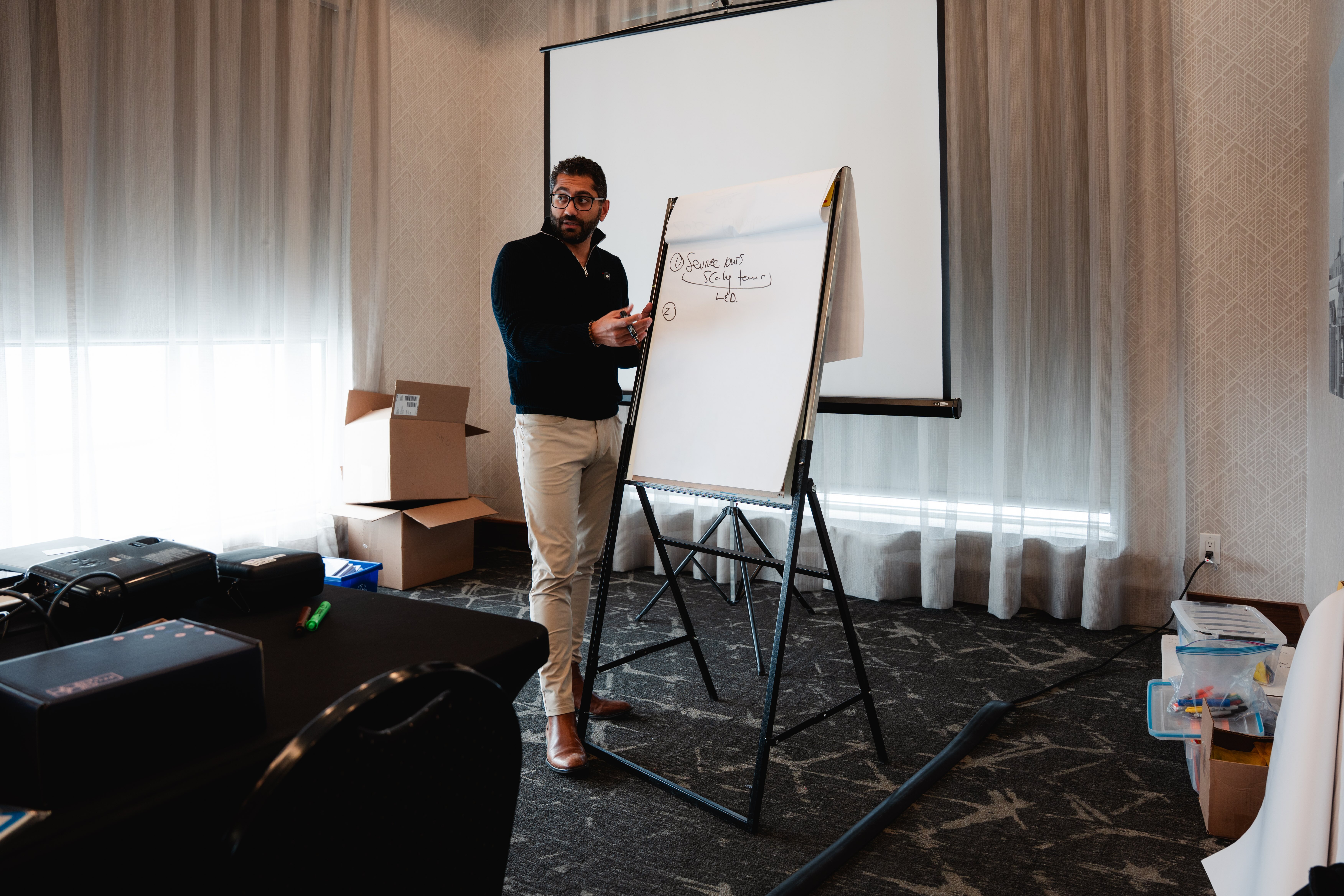
In the early days you are doing. You build, you sell, you ship, and you are good at it. Then you start managing, directing other people who do the work. This shift is uncomfortable but most founders manage it, because it still feels like control. The final shift, the one most founders never fully make, is to multiplying: building leaders who build other leaders, so the organization's capacity grows beyond your own.
Liz Wiseman's research names the pattern precisely. Across more than 150 leaders in 35 companies, she and Greg McKeown found that the best leaders, the Multipliers, extract 70 to 100% of their people's capability, while Diminishers access only 20 to 50%. Roughly twice the capability from the same team.
Here is the finding that matters most for founders, and it's the one the original version of this argument usually leaves out. Wiseman found that about two-thirds of diminishing behaviour is accidental. It doesn't come from tyrants. It comes from capable, well-meaning people who are so good at having the answer that they train everyone around them to stop looking for it.
That's you, if you're not careful. Every time you solve a problem your team could have solved, you teach them to bring you the next one. You are not being a control freak. You are being helpful, and being helpful is quietly making your team less capable. Wiseman calls this the Accidental Diminisher, and founders are exceptionally prone to it precisely because they earned their seat by being the one with the answers.
John Maxwell calls the ceiling on all of this the Law of the Lid: your organization cannot outgrow your own leadership capacity. If you want a bigger company, you raise your lid, then build leaders who raise theirs. We go deeper on that ceiling in the leadership lid.
The Growth Stages Where Scaling Leadership Breaks
Scaling leadership is not one event. It breaks at predictable headcount lines. Know them and you can get ahead of the pain instead of reacting to it.
Around 10 to 15 people
The flat structure still works. You do, and you direct everyone directly. The first hairline cracks appear: you are in every conversation and starting to feel stretched thin.
Around 20 to 30 people
This is the first real wall. The flat structure breaks, you can no longer hold a direct line to everyone, and you have to hire your first real managers. You start leading teams of teams instead of individuals.
This is also where founders make the single most expensive scaling mistake we see, and it's worth spending a moment on because it's so common.
The founder brings in their first senior outside hire, usually a VP, around the 25-person mark. They're thrilled about it. They pay a lot for it. And then they say some version of: "You're the VP, so you're empowered, go make the decisions." The VP, who has never worked inside this company, nods, says "I think I get it," and pulls the organization in a completely different direction.
In our experience, that first VP hire is almost always gone within a year, and the founder concludes it "just wasn't a good fit."
It wasn't a fit problem. It was a management problem. Even a senior, expensive, deeply experienced VP needs to be brought into your context deliberately rather than handed the keys on day one. Which is the whole idea behind how you actually delegate, and it's the next section.
Around 50 to 75 people
Now you need real management structure and, often, your first VPs sitting over managers. This is where the founder-to-CEO transition gets real. Your job becomes coaching leaders, not being the top individual contributor. If you are still the best individual contributor in the building, something has gone wrong. We map this whole shift in founder mode versus CEO mode.
Around 150 people
150 is often cited as Dunbar's number, a rough rule of thumb for how many stable relationships one person can maintain. Treat it as a heuristic rather than a hard law, because the specific figure is debated. But the underlying pattern holds: at some point the informal "everybody knows everybody" culture stops working, and you need formal systems, clear communication channels, and real management layers. Companies that stall here usually failed to evolve the organization, not the product.
How to Actually Build a Layer of Leaders
Knowing the shift is one thing. Here is how to make it happen.
Replace yourself with a system, not a hero
You cannot trust your way out of a bottleneck. You build your way out.
The founders who escape install an operating system. We call it the Founder Operating System, and the specifics matter less than the principle: OKRs so people know what actually matters, weekly metrics so teams can self-correct without asking you, and a leadership cadence so coordination happens in a rhythm rather than through your inbox. That system, not you, becomes the thing that keeps the company aligned.
Often a chief of staff or COO is the person who owns and runs the system day to day. Your job is to build it, not to be it.
Delegate in levels, not all at once
Delegation is not binary, and this is exactly where the first-VP disaster comes from. Handing someone full authority on day one isn't empowerment. It's abdication.
We teach delegation as a spectrum with four stages:
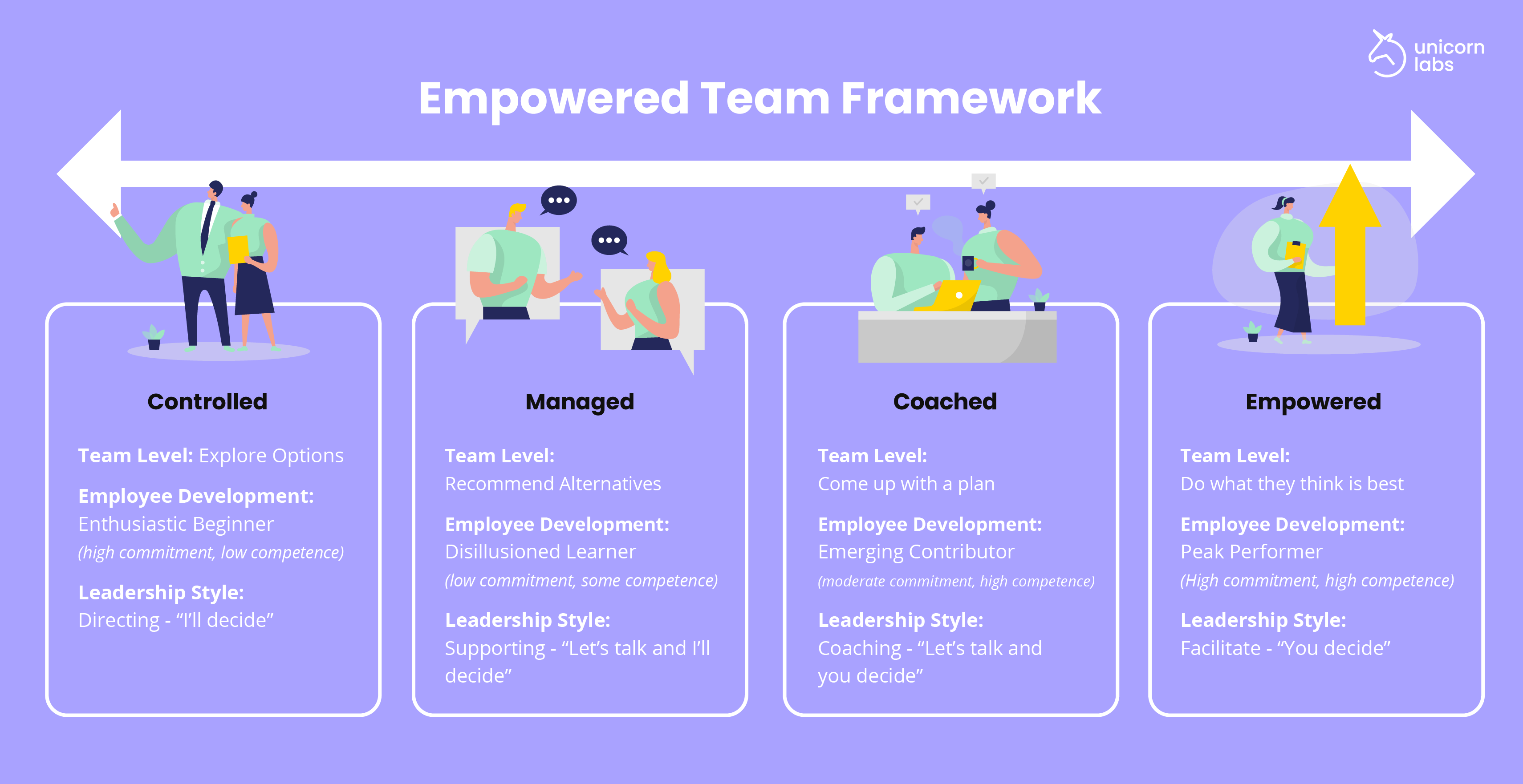
- Controlled. You specify exactly what to do. This is teaching, not micromanaging, and it's where every new relationship starts, even a senior one.
- Managed. You set priorities together and hand over a clear checklist. They execute with defined expectations.
- Coached. You give them room to make their own decisions, then debrief and give feedback. They're playing the game now; you're on the sideline.
- Empowered. They decide, they tell you what's best, and you support it.
The mistake founders make is skipping straight to Empowered because they're too busy to do the earlier stages, then yanking people all the way back to Controlled the moment someone makes a mistake. That whiplash destroys trust in both directions. The more senior the person, the faster they can move through the stages, but you do not get to skip them. Our guide on escaping the founder bottleneck walks through the mechanics.
Coach more than you direct
When a leader brings you a problem, fight the urge to solve it. Ask what they would do.
Most of the time they already know, and your job is to build their judgment rather than rent them yours. A founder who coaches is building Multipliers. A founder who answers every question is building dependents, and training themselves deeper into the bottleneck.
This is the daily, practical antidote to accidental diminishing. The reflex to be helpful is the thing to resist.
Hire for whether they grow people
When you hire leaders, don't screen only for raw skill. Screen for whether they make the people around them better.
One Diminisher in a VP seat can quietly shrink an entire department, and because two-thirds of diminishing is unintentional, they'll do it while believing they're doing a great job. One Multiplier can lift a department beyond what its headcount suggests is possible. You're not just hiring capability. You're hiring for whether that capability compounds or concentrates. That's the real definition of building a high-performing team.
One more piece of evidence this is worth the effort. Gallup's research on entrepreneurs found that only about one in four have high Delegator talent, and those who do posted an average three-year growth rate of 1,751%, which is 112 percentage points higher than founders with low Delegator talent. Delegation isn't just how you get your evenings back. It correlates with dramatically faster growth.
The Goal Is a Company That Doesn't Need You
Remember the one-week test? Flip it.
The goal of scaling leadership is a company that runs beautifully while you're gone. Not because you're irreplaceable, but because you built people who make you replaceable.
That's the real measure. Not how many decisions run through you, but how few have to. You stop being the smartest person in the room and become the person who made the room smart.
The company grows to the size of your leadership. So build the layer of leaders, install the system, resist the urge to be the answer, and make your leadership bigger than you.
Frequently Asked Questions:
Now that you have mastered how to manage conflict - what is your plan of action for making an impact with your team?
Now that you have mastered how to create an environment of empowerment via the 3-P's - what is your plan of action for making an impact with your team?
Developing Your Communication, Empathy and Emotional Intelligence skills is start. What is your plan of action for implementing your learnings within your your team?
Now that you understand the differences in these titles - what is your plan of action for what you learned?
Assessing your team's behaviors is a start - but do you have a plan of action for the results?
Now that you have mastered the art of decision making - what is your plan of action for making an impact with your team?
.png)
A DISC Behaviour Assessment is the best way to understand your team's personalities.
Each DISC Assessment includes a Self Assessment and DISC Style evaluation worksheet
.webp)


