


Team Building for Remote Teams: 6 Rituals That Build Trust
Team building for remote teams works best as a set of small rituals that repeat every week and make people feel seen. Two minutes at the start of a weekly meeting. A norm the team wrote down together. A demo of half-finished work. Keep them going for a quarter and they build more trust than any virtual escape room.
The need is real. On any given day, 25% of fully remote employees told Gallup they had felt lonely a lot of the day before, compared with 21% of hybrid workers and 16% of people fully on-site.
So most companies reach for trivia night. Another hour on Zoom, mandatory fun, cameras on. Your engineers would rather sit through a root canal, and who can blame them?
Why Does Most Remote Team Building Fail?
The standard playbook puts everyone in a virtual room, adds a game and hopes bonding happens. It rarely does, because a game skips the thing trust is made of: small moments of being seen and accepted.
Skipping it costs money. Disengagement cost the world economy about $10 trillion in lost productivity in 2025, or 9% of global GDP, according to Gallup’s State of the Global Workplace. Loneliness has a price of its own. The New Economics Foundation estimated that loneliness costs UK employers £2.5 billion a year, and £1.62 billion of that comes from people leaving. That figure is UK-only and from 2017, but the pattern holds anywhere: people who feel disconnected stop showing up, and then they stop working for you.
Timing makes it worse. Most companies schedule team building as a reaction. Engagement scores dip, someone books an event, and the invite lands with “mandatory” in the subject line. Your team reads the subtext in a second, and one afternoon on Zoom doesn’t change how Tuesday feels.
The other failure is forced vulnerability. Icebreakers that ask for personal disclosure from people who don’t feel safe yet tend to backfire. Safety has to come first, which is why the rituals below start small and get deeper over time.
What Do Remote Teams Need Instead of Icebreakers?
Daniel Coyle, who studied highly successful groups for The Culture Code, calls the raw material of trust “belonging cues”: behaviours like eye contact, turn-taking, attention and energy that create safe connection in a group. Each one is a small signal that says you’re safe here and you’re one of us. One signal isn’t enough. They have to keep coming.
In an office, belonging cues happen by accident. You overhear a joke, someone grabs you a coffee, a colleague notices you’ve gone quiet. Remotely, they only happen if someone builds them in.
I learned this years before I had the research language for it.
In high school, my friend Mo and I ran a March Break camp for kids in Ottawa’s Lowertown. One lunch, a seven-year-old sitting next to me pulled out a box of Kraft Dinner. Dry. Uncooked. Just the box. He shook it, looked me dead in the eye, and said, “I like dry mac and cheese.”
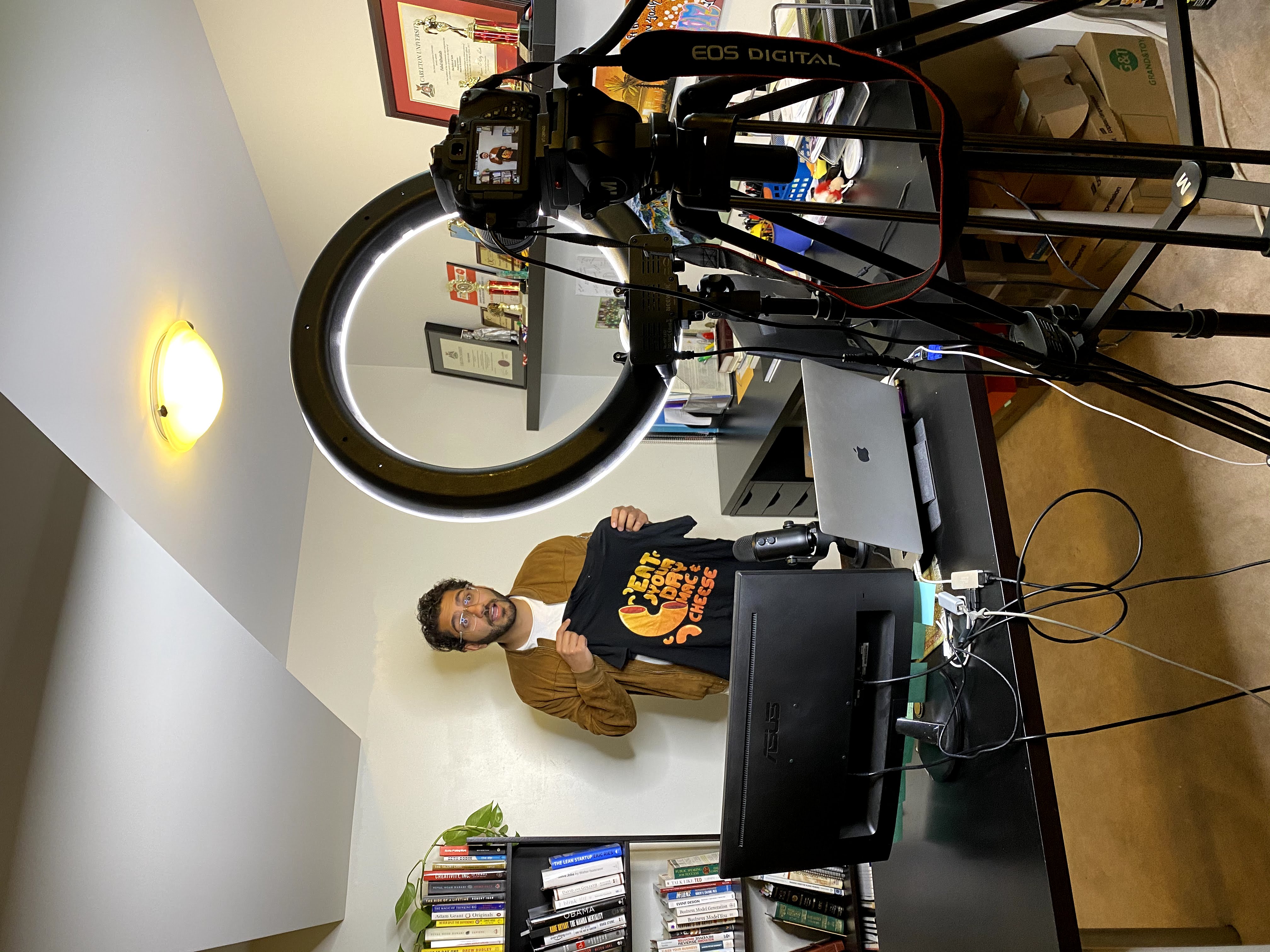
I was about to burst out laughing. I was holding it in.
Then Mo came running over. “Oh my god. Is that dry mac and cheese? Can I have some?”
The kid handed him the box. Mo reached in, grabbed a handful of dry noodles and started eating them. Then the kid with the Dunkaroos, the kid with the Fruit Roll-Ups and the kid with the jumbo bag of Doritos all turned to him and said, “Trade ya.”
I pulled Mo aside. “You don’t seriously like dry mac and cheese, do you?”
He swallowed hard. “That was one of the most disgusting things I’ve ever tried.”
To this day, I don’t remember the kid’s real name. We called him Mac. He had the best week of camp: playing the games, doing the science experiments, singing the songs. On the last day I got an email from his mother. The subject line said, “What have you done with my child?”
He had always struggled to make friends on his own, she wrote. That afternoon he’d come home, dropped his bag and run to the park with his new friends.
If I had laughed, I don’t know if the other kids would have traded. One small act of acceptance changed that kid’s week. I’ve been looking for more mac and cheese moments ever since, and remote teams need a steady supply of them.
Google’s Project Aristotle studied 180 teams and found that what made them effective was “less about who is on the team, and more about how the team worked together.” Psychological safety topped its list. So the useful question for a remote team is which repeatable rituals send safety signals through a screen. You can read more on why psychological safety matters at work, and the practical version follows below.
Our own data points the same way. Across 78 team assessments and more than 900 people, psychological safety averages 4.08 out of 5. Effective communication averages 3.71, and it swings more than any other level we measure, from 2.75 on some teams to 4.58 on others. Our State of Teams research reads that spread as a ritual gap: communication rises and falls with whether a team’s leaders have built deliberate habits for it.
One more number before you plan a happy hour. In one assessment we ran, “I have a best friend at work” scored 3.33 out of 5, while inclusion scored 4.83. Inclusion ran high without the friendships, and inclusion is built from how people treat each other in the work itself, which is where the rituals below live.
Which Remote Team Building Activities Build Trust?
Five of these take 30 minutes or less. The sixth, a norms session, takes an hour once a quarter. Each one targets a specific trust signal, and none of them involves a trust fall.
1. The User Manual Exchange
Everyone writes a one-page “how to work with me” doc: when they do their best thinking, how they like to receive feedback, what their silence means. Share them in a 30-minute session where each person walks the team through theirs in three minutes.
It turns personality friction into information you can plan around. People finally have words for how they operate, and a DISC workshop for teams sharpens those words further. Leadership teams run a version of this at offsites, which we cover in leadership team building that works.
2. Mac and Cheese Check-Ins
Open one meeting a week with a two-minute round: “What’s one weird or wonderful thing from your week?” Skip work status and go for the dry-noodle stuff. The manager goes first and shares something real.
An office produces these small disclosures by accident. A two-minute round produces them on purpose, every week, which is the steady supply of belonging cues Coyle describes.
3. The Two-Minute Shout-Out Round
Start your team meeting with open-floor recognition. Anyone can call out a teammate’s specific recent effort. Keep it specific and under two minutes in total.
Recognition costs nothing and it keeps people. In a study Gallup ran with Workhuman, a company that sells recognition software, well-recognized employees were 45% less likely to have left two years later. Ask people to name what their teammate did: “you caught the billing bug before it shipped” lands in a way “great job” never will.
4. The Team Norms Working Session
Once a quarter, spend 60 minutes deciding how you work: how fast people should reply, when cameras are on, where decisions get logged, how disagreement happens. Write it down. Revisit it next quarter. Our team norms workshop agenda has the full script.
Ambiguity costs remote teams something every day, and written norms remove a lot of it. If you’re forming a new team or moving one to remote, start here.
5. Show Your Work Fridays
Every other Friday, two people demo something unfinished for ten minutes: a half-built feature, a messy draft, a failed experiment. The audience follows one rule, questions before opinions.
Showing rough work in public builds what Timothy R. Clark calls learner safety: space to ask questions, experiment and make mistakes without fear. It also means problems surface while they’re still small. When something does go wrong, a blameless postmortem runs on the same habit.
6. Cross-Team Coffees With One Real Question
Randomly pair people from different functions for a 20-minute virtual coffee, twice a month. Give each pair one question that goes a little deeper than small talk: “What’s a hill you’d die on professionally?” or “What did your first job teach you?”
Remote work shrinks the circle of people you talk to. When Microsoft moved its whole company remote in 2020, collaboration got more siloed, and the time people spent working across groups fell by about 25%. Random pairing is a cheap way to push back, and the seeded question gets each pair past the weather. If you already run open-ended coffee roulette (one of our psychological safety exercises for remote engineering teams), add the question.
Should Remote Teams Meet in Person?
Yes, when you can, and design it like you mean it. Meeting once or twice a year builds shared context that every later video call draws on.
Apply the same rule you use online: connection over content. Cut the eight-hour slide marathon. Fill the agenda with the things a screen can’t carry: shared meals, unstructured time, and working sessions where people solve a real problem side by side. A norms session makes a strong first morning. Our guide to planning a retreat that works covers the rest.
If the budget only stretches to one event a year, spend it on a kickoff when a team forms. The trust it builds has a whole year to pay off, and a party in December mostly buys nostalgia.
How Do You Make Remote Team Building Stick?
Notice what’s missing from the list: the annual virtual escape room. Every ritual above repeats, because the signals trust is built from have to keep coming.
Pick two activities, run them for a full quarter, and only then add a third. If your team is recovering from something heavier, like a restructuring, the order matters even more. We cover that in rebuilding trust after layoffs.
Then measure it. Our data shows where most teams have room to grow: in telling each other the truth. Without a baseline, you’re guessing which rituals to run. With one, you can show your leadership team the before and after, and team building becomes a line item that defends itself. Our guide to measuring psychological safety shows how to do it without killing it.
Back to the Box of Kraft Dinner
Mo didn’t plan a team-building event. He ate a handful of dry noodles at the right moment, and a seven-year-old had the best week of his camp.
What remote teams are short on is belonging, and belonging is built from small, repeated signals of acceptance: the shout-out, the check-in, the norm you wrote down together, the dry mac and cheese someone dared to share.
Want to know where your team stands? Take the Team Dynamics 360 Assessment to see which of the six levels your team needs first, or bring us in to run a team building workshop built on the same model.
Frequently Asked Questions:
Now that you have mastered how to manage conflict - what is your plan of action for making an impact with your team?
Now that you have mastered how to create an environment of empowerment via the 3-P's - what is your plan of action for making an impact with your team?
Developing Your Communication, Empathy and Emotional Intelligence skills is start. What is your plan of action for implementing your learnings within your your team?
Now that you understand the differences in these titles - what is your plan of action for what you learned?
Assessing your team's behaviors is a start - but do you have a plan of action for the results?
Now that you have mastered the art of decision making - what is your plan of action for making an impact with your team?

A DISC Behaviour Assessment is the best way to understand your team's personalities.
Each DISC Assessment includes a Self Assessment and DISC Style evaluation worksheet


