
Leadership

How to Mediate Cofounder Conflict (Before It's Fatal)

Table of Contents:

Your competitors probably won’t kill your startup. Your cofounder relationship might.

The venture investor Bill Sahlman’s oft-cited analysis of why startups fail concluded that people problems, not product, accounted for roughly 65% of the reasons companies go under. And the sharpest edge of that sits at the very top: the two or three people who started the thing together.

If you’re reading this, something between you and your cofounder is already off. Good. You’re early. Here’s how to mediate cofounder conflict while it’s still a conversation and not a lawsuit, drawn from the same playbook we use in conflict resolution work with leadership teams.
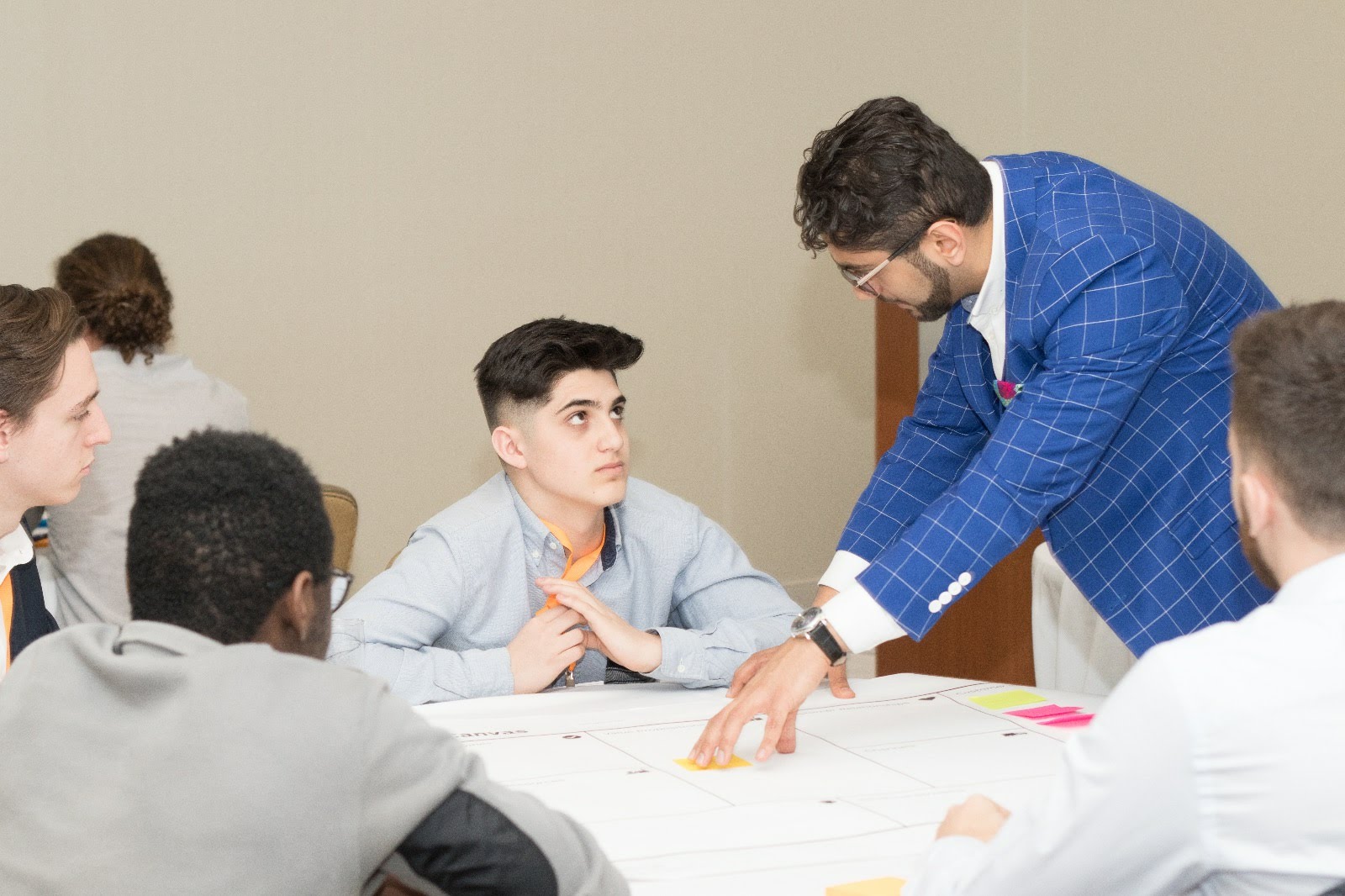
Fahd Alhattab coaching a young participant through a canvas worksheet exercise at a leadership workshop table, pointing to a sticky note while the group works

‍

Why Cofounder Conflict Feels Impossible to Raise

You can fire a bad executive. You can’t easily fire the person who owns 30% of the company and stood beside you at the wedding.

That’s the trap the research exposes. In The Founder’s Dilemmas, Noam Wasserman found that founding teams made of friends and family actually fail more often than teams of acquaintances, and the reason is brutal in its simplicity: they avoid hard conversations to protect the relationship. The closeness that made you cofounders is the exact thing that stops you from saying “this isn’t working.”

So the conflict goes underground. You stop debating in meetings and start recruiting allies after them. Your exec team notices within weeks. I’ve sat with leadership teams who could describe the founder cold war in detail while both founders swore nobody knew.

Silence isn’t protecting your company. It’s picking a slower way to lose it.

‍

Step 1: Diagnose What Kind of Conflict You Actually Have

Before you mediate anything, name the category. Most founder fights are one of three, and they need different treatments. This mirrors the distinction between task conflict and relationship conflict that shows up in every team, just with equity attached.

Step 1: Diagnose

Most founder fights are one of three types

Name the category before you mediate. Each one needs a different treatment.

Structural: the roles outgrew the people

The most common one. At five people, you both did everything. At fifty, you're tripping over each other. When decision rights were never written down, every disagreement becomes a turf war in disguise.

The tell: your fights are about specific decisions, but the same pattern repeats across unrelated topics.

Directional: two companies in one cap table

One of you wants to raise and swing big. The other wants profitable and calm. Neither is wrong. But a company can only run one strategy at a time, and pretending otherwise burns cash while you both wait to be proven right.

The tell: your fights spike around fundraising, hiring plans, and annual planning.

Style: you process the world differently

One founder decides in the meeting; the other needs two days and a document. One reads directness as honesty; the other reads it as contempt. These clashes masquerade as disrespect when they're really wiring. A DISC assessment takes an hour and turns half these fights into vocabulary problems instead of character problems.

The tell: you agree on the destination but fight about every meeting on the way there.

‍

Step 2: Run the Mediation Conversation

Once you’ve named the category, get in a room. Not a Slack thread. Not a board meeting. The fundamentals of resolving conflict at work still apply, but the founder version needs more structure. Here’s the sequence we use, and it works best on neutral ground with phones away and 90 minutes protected.

Step 2: The Conversation

The 90-Minute Mediation Sequence

Neutral ground, phones away, 90 minutes protected.

1

Open with stakes, not grievances

First words matter. Try: "I think we've been avoiding this for months, and the company is paying for it. I want us to fix it, not win it." You've named the elephant and declared you're not there to prosecute.

2

Trade perspectives before solutions

Each founder gets ten uninterrupted minutes on two questions: "What do you think is happening?" and "What are you afraid of?" That fear question does the heavy lifting. Underneath "you keep overriding my product decisions" usually lives "I'm afraid I'm becoming an employee in my own company." You can negotiate roles. You can't negotiate an unspoken fear.

3

Separate the facts from the story

Patrick Lencioni's work on team dysfunction shows how fast teams slide from observations into narratives. "You missed three exec meetings" is a fact. "You've checked out" is a story. Put the facts on a whiteboard and make each founder defend their story against them. Most stories shrink fast under that light.

4

Leave with written decision rights

Don't leave the room with vibes. Leave with a document: which decisions are yours alone, which are your cofounder's alone, and which need both signatures. Keep the "both" list under five items, because everything on it is a future fight. Revisit it every quarter.

‍

Step 3: Know When You Need a Third Party

Self-mediation has a ceiling. Bring in a neutral outsider when any of these are true.

Step 3: Escalate

When to Bring in a Neutral Third Party

You've tried to resolve it yourselves twice and it keeps resurfacing

Two honest attempts that don't hold means the problem is bigger than the two of you can see from inside it.

The conflict touches equity, vesting, or an exit

Once the cap table is in play, every conversation carries a financial charge that neutral framing can't hold on its own.

There's a real power imbalance between you

When one founder is CEO and the other reports to them in practice, the quieter founder won't speak freely without a neutral in the room.

Your exec team has started routing around one of you

When people shop decisions to whichever founder will say yes, the dysfunction has already left the founder relationship and is taxing the whole company.

You can feel it getting personal

When the fights have stopped being about decisions and started being about character, you need someone whose only job is to pull it back to the facts.

A neutral mediator changes the physics of the room. Each founder gets a confidential pre-conversation, which surfaces the things neither will say with the other present. And an experienced third party has seen fifty versions of your fight, so they can name the pattern in minutes instead of months. This is why board members make poor mediators: they have a position in the outcome, and everyone knows it.

Confidentiality is the whole game here. Founders tell us things in pre-work they’ve never said aloud, and that raw material is what makes the joint session work.

‍

What This Looks Like When It Works

One pair of founders we worked with hadn’t made a joint decision in two quarters. Classic structural conflict: the company had tripled, and both still believed they owned product direction. Their exec team had learned to shop decisions to whichever founder would say yes.

The fix wasn’t therapy. It was ninety minutes of the process above, a written decision-rights table, and a standing biweekly founder 1:1 with two fixed questions: “What decision am I sitting on that you disagree with?” and “Where did I step on your turf?”

Six weeks later their exec team asked what changed. Nothing dramatic had. The founders had simply stopped making the whole company mediate their silence. If the bottleneck runs deeper than the relationship, that’s usually a founder role-design problem, which is what our Founder Operating System work addresses head-on.

‍

The Relationship Is the Runway

Here’s the reframe to carry out of this post. Cofounder conflict isn’t a sign you chose the wrong partner. It’s a sign the company grew and your operating agreement didn’t.

Every scaled founding team you admire has had this fight. The survivors aren’t the ones who never clashed. They’re the ones who treated the partnership like the company’s most valuable system: maintained on a schedule, not repaired after the crash. Choose the hard conversation now. The easy silence costs more.

Don't Wait for the Board to Notice

Is the conversation too far gone to run alone?

Book a confidential call and we'll tell you honestly whether you need mediation, executive coaching, or just a decision-rights document.

Book a Confidential Call → Or see how executive coaching helps founders →

‍


 Frequently Asked Questions:


From the Blog

Now that you have mastered how to manage conflict - what is your plan of action for making an impact with your team?

Now that you have mastered how to create an environment of empowerment via the 3-P's - what is your plan of action for making an impact with your team?

Developing Your Communication, Empathy and Emotional Intelligence skills is start. What is your plan of action for implementing your learnings within your your team?

Now that you understand the differences in these titles - what is your plan of action for what you learned?

Assessing your team's behaviors is a start - but do you have a plan of action for the results?

Now that you have mastered the art of decision making - what is your plan of action for making an impact with your team?

Download your free leadership guide that outlines the 6 necessary steps you need to acheive in order to develop a high performing team (in weeks, not months).  
Help your managers improve their managing of communication, collaboration and conflict. Download your free leadership guide that outlines the 6 necessary steps you need to achieve in order to develop a high performing team (in weeks, not months).
Download your free leadership guide that outlines the 6 necessary steps you need to acheive in order to develop a high performing team (in weeks, not months).  
Get My Free Leadership Guide Now

A DISC Behaviour Assessment is the best way to understand your team's personalities.

Start by understanding your own behaviour tendencies with a DISC assessment. Learn more about how a DISC Assessment will improve your potential as a leader!

Each DISC Assessment includes a Self Assessment and DISC Style evaluation worksheet
Bill Gates Training Sidebar
Bill Gates Leadership

Curious how to develop into a transformational leader like Bill Gates?

Start by accessing our FREE Training video that outlines six simple steps for creating an environment that will transform YOU, and YOUR TEAM, into Unicorn leaders.

Leadership Training Ad - Sidebar
Leadership Training

Are you ready to transform from just a manager into a Unicorn Leader?

You can access our FREE training that will give you clarity on how to create a successful team in just six steps.

Leadership Training Ad - Sidebar
Leadership Training

Curious on some tips for transforming your managers into leaders?

Access our BEST, free training video that HR leaders are using to inspire real conversations with their managers.

In less than 25 minutes, you can gain clarity on how to turn your teams into centers for growth.

Access FREE Leadership Training Now
Career Conversations Sidebar
Career Conversations Guide

Is Your Company Culture Stuck In A Rut? Sometimes creating an environment for continuous learning can make a huge difference.

We created the best guide for having career development conversations with your teams.

Increase motivation and retain your top talent by following these simple steps.

EQ Leadership Sidebar
EQ Leadership Image

Did you know that EQ is more valuable to a leader than IQ?

We created the BEST, FREE training video to help managers map out a clear path for transformation into a Unicorn Leader.

Are you ready for your leadership transformation?

Access FREE Leadership Training Now
Leadership Workshop Sidebar
Leadership Workshop Image

Empowering your team to make decisions is just the start. Are you also supporting the other key elements for a high-performing team?

An investment in your team's development is an investment in your company's ability to effectively scale.

We've created an experiential, virtual workshop that focuses on developing teams into scalable engines of growth.

Interested in customizing a workshop for your team?

Learn More About The Leadership Workshop

Related posts